Pool Pump Weighted Energy Factor: What WEF Measures
The pool pump weighted energy factor is gallons moved per kilowatt-hour on a standard test. What WEF includes, what it leaves out, and how to read it.
The pool pump weighted energy factor is the one number on a pump's label that actually predicts your electricity bill, and almost nobody explains what it is. This guide works through what WEF measures, where the figure comes from, what it deliberately ignores, and how to read it without being misled by a pump's advertised horsepower.
What the pool pump weighted energy factor measures
WEF is a ratio: water out, divided by electricity in. It is published in thousands of gallons per kilowatt-hour, so a pump certified at 10.0 moved ten thousand gallons for every kilowatt-hour it consumed during its test. Higher is better, in the plain sense that you get more circulation for the same money.
The ENERGY STAR specification for pool pumps defines it as a measurement of pump efficiency based on performance at one or two operating points, measured in kgal/kWh, with those points weighted to represent real-world use. Two parts of that definition carry all the weight. "One or two operating points" tells you the number is not a full map of the pump's behaviour — it is a sample. "Weighted to represent real-world use" tells you the sample is deliberately skewed towards how pumps are actually run, which for a modern pool pump means mostly slow.
That weighting is the whole reason the metric exists. An older efficiency measure, energy factor, is simply gallons per watt-hour at a single condition. If you rate a two-speed or variable-speed pump at full tilt, you learn nothing about the eight or ten hours a day it spends loafing along at a third of maximum speed drawing a tenth of the power. WEF samples low speed and high speed and weights them, so a pump that is efficient where it spends its time scores well and a pump that is only efficient flat out does not.
Where the number comes from
The ENERGY STAR programme does not define the test itself. Its specification assigns WEF measurement to the United States Department of Energy's test procedure for dedicated-purpose pool pumps, cited as 10 CFR 431.464(b), and then sets the thresholds a pump must clear to earn the label. So the number on a certified record is a federal test result, not a marketing figure a manufacturer chose how to compute.
The test puts the pump on reference system curves — labelled A, B and C in the procedure — which stand in for three different plumbing resistances. Curve C is the one used for the horsepower rating. The record for each certified pump publishes flow in gallons per minute, head in feet of water, speed in rpm and input power in watts at each measurement point, plus the flow and power on each reference curve at maximum speed. That is unusually complete for a consumer product: you can see not just the score but the measurements behind it.
One field on every record matters as much as WEF itself. Rated hydraulic horsepower is the water power the pump actually produced in the test. It is not the number on the motor's nameplate. The nameplate figure is a motor rating that includes the motor's own losses and often a service factor, and it is close to useless for comparison. Among the certified records held on this site, pumps advertised at a nameplate 1.5 to 1.75 horsepower range from 0.491 to 1.242 rated hydraulic horsepower — a factor of two and a half in the water power they can actually deliver, at the same advertised size.
Why a high pool pump weighted energy factor is not automatically good
Here is the trap. The WEF threshold is not a flat bar, and it is not one rule. ENERGY STAR's Version 2.0 criteria table splits pumps into six cases by sub-type and size, and each case has its own line. Three are formulas in hydraulic horsepower; three are flat values, two of them floors for the smallest pumps and one covering booster pumps at any size. Applying the wrong one of the six gives a nonsense answer, so the whole table is worth having in front of you:
| Sub-type | Size class | Version 2.0 minimum WEF | Certified records governed by it |
|---|---|---|---|
| Self-priming, in-ground | hhp ≥ 0.711 | −2.30 × ln(hhp) + 6.59 | 240 |
| Self-priming, in-ground | 0.13 < hhp < 0.711 | −1.30 × ln(hhp) + 4.95 | 90 |
| Self-priming, in-ground | hhp ≤ 0.13 | 7.60, flat | 0 |
| Non-self-priming, above-ground | hhp > 0.13 | −1.00 × ln(hhp) + 3.85 | 80 |
| Non-self-priming, above-ground | hhp ≤ 0.13 | 4.92, flat | 3 |
| Pressure cleaner booster | all sizes | 0.45, flat | 10 |
Those counts are the 423 certified records retrieved on 17 October 2026, sorted into the case that governs each. I then checked every record against its own case: all 423 published minimums reproduce their Version 2.0 line to within 0.01. None are being held to Version 3.0.
That check only works case by case. Applied blindly to the whole list, the headline self-priming formula misses on 183 of the 423 records, because those 183 are governed by one of the other five lines — and the misses are not small. The Hayward Booster Pump at 0.218 hhp publishes a minimum of 0.45, where the self-priming formula would demand 10.09. The Blue Torrent EZ 500 at 0.073 hhp publishes 4.92 against a formula value of 12.61. Neither is an error in the data; they are simply different rules.
Within a single rule the bar does fall as the pump gets bigger, and Version 3.0 raises it across the board:
| Rated hydraulic horsepower | Governing Version 2.0 rule | Version 2.0 minimum | Version 3.0 minimum |
|---|---|---|---|
| 0.35 | Self-priming, small | 6.31 | 10.97 |
| 0.50 | Self-priming, small | 5.85 | 10.10 |
| 0.70 | Self-priming, small | 5.41 | 9.27 |
| 0.711 | Self-priming, standard | 7.37 | 9.24 |
| 0.881 | Self-priming, standard | 6.88 | 8.71 |
| 1.00 | Self-priming, standard | 6.59 | 8.40 |
| 1.50 | Self-priming, standard | 5.66 | 7.41 |
| 1.883 | Self-priming, standard | 5.13 | 6.85 |
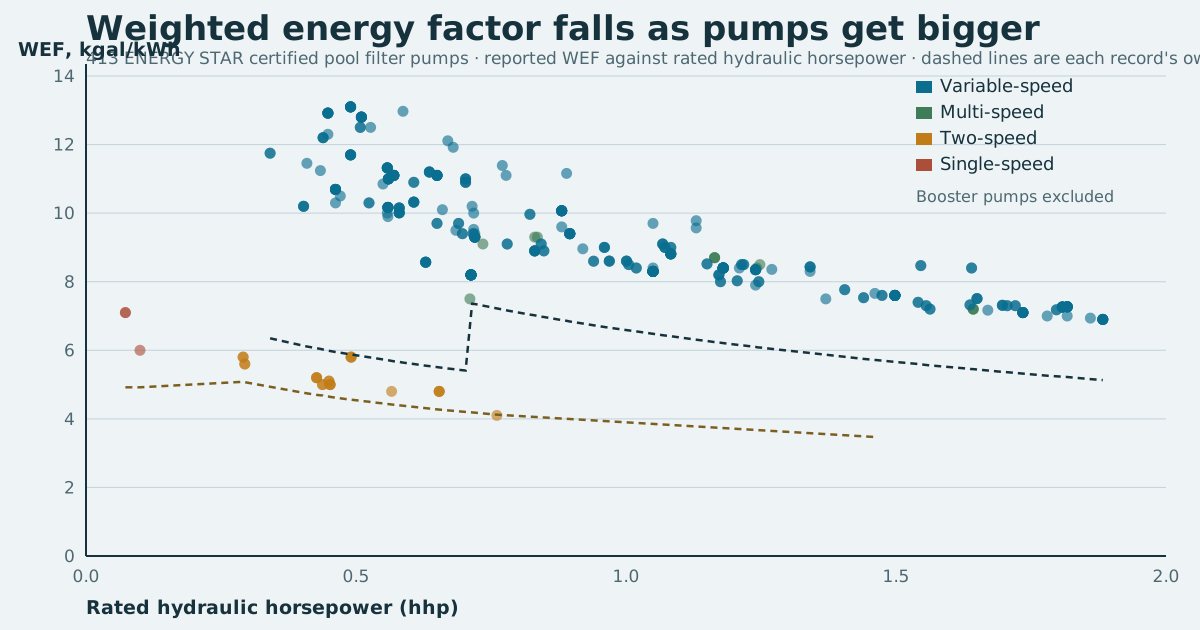
Read down the Version 2.0 column and it falls, then jumps from 5.41 to 7.37 at the 0.711 boundary, then falls again. That step is real: the two self-priming lines are different lines, and a pump that creeps over the small/standard boundary faces a sharply higher bar. It is also one more reason the raw number is not comparable across sizes. Under Version 3.0 the small and standard classes share a single formula, so the step disappears.
Two things follow. First, comparing the raw WEF of a 0.5 hhp pump with a 1.9 hhp pump tells you almost nothing — they are measured against different bars. The honest comparison is a pump's WEF against the minimum printed on its own record, which is why every model page here shows both and the margin between them. Second, the tightening is real but most of the list is ahead of it: applying the Version 3.0 self-priming formula to the same records, 318 of the 330 in-ground pumps would still clear it and 12 would not.
Sub-type matters as much as size
Above-ground pumps are held to a different and much lower line: minus 1.00 times the natural logarithm of hydraulic horsepower, plus 3.85. A 0.5 hhp above-ground pump needs only 4.54 where a self-priming pump of the same size needs 5.85. That is a deliberate recognition that the two jobs are different — an above-ground pump sits at water level and does not have to lift and prime — but it means an above-ground pump showing a WEF of 12 is not therefore better than an in-ground pump showing 9.
What the certified list looks like by speed class
The shape of the list itself tells you something about where WEF has pushed the market. Of the 423 certified records retrieved on 17 October 2026, 376 are variable-speed, 22 are two-speed, 12 are multi-speed and just 13 are single-speed — and every one of those single-speed records is either an above-ground pump or a pressure cleaner booster pump. There is not one single-speed in-ground filter pump on the list.
That is not an accident of sampling. A metric that weights low-speed performance, combined with a threshold that a fixed-speed motor struggles to clear at in-ground sizes, makes certification very hard for a design that can only run flat out. If you are replacing a single-speed in-ground pump, the practical consequence is that there is no certified like-for-like swap: the comparison you are making is between your existing pump and a variable-speed one, and the gap is mostly in those low-speed watts rather than in the headline rating.
Booster pumps are a different world again. The ten certified pressure cleaner booster pumps on the list report WEF between 0.591 and 0.703, roughly an order of magnitude below filter pumps, against a threshold of 0.45. They exist to force water through a pressure-side cleaner, not to circulate a pool, and comparing their numbers with a filter pump's is meaningless.
What the metric leaves out
WEF is a good metric that answers a narrow question. The gaps are worth naming.
It has no hours and no tariff in it. WEF is a ratio, so there is no time in it anywhere and no money. A pump with a WEF of 12 run sixteen hours a day costs more to run than a pump with a WEF of 8 run six hours. To turn a certified record into a bill you need the input power in watts at the speed you actually run, the hours, and your own price per kilowatt-hour — which is exactly what the energy cost calculator on this site does with the published watts.
It assumes the test's plumbing, not yours. The reference curves are standardised resistances. Your pool's pipe diameter, fittings, filter condition and plumbing runs set a different resistance, and at a given rpm more resistance means less flow and usually more watts. A certified figure is a fair basis for comparing pumps against each other. It is not a prediction of your pump's draw, and the only way to know that is to measure at the pump feed.
It says nothing about whether the pump suits your pool. Efficiency is irrelevant if the flow is wrong. A pump has to move enough water to turn the pool over in a reasonable time, and it has to do it against the head your plumbing presents. Sizing is a flow question, which the turnover calculator here handles, and WEF only becomes interesting once two candidates can both do the job.
It does not cover standby, except where separately published. Standby power — the controller awake, motor idle — is reported as its own field on many records, ranging from 1 to 8 watts across the detailed set. Small, but it runs whenever the pump does not, and over the hours that adds up to a real if modest number.
It does not tell you a variable-speed pump's savings. This is the most common misreading. A variable-speed pump's advantage comes from the physics of running slowly: power falls roughly with the cube of speed while flow falls roughly in proportion, so halving the speed and doubling the hours delivers similar turnover for far less energy. WEF partially captures that by weighting the low-speed point, but the actual saving in your pool depends on the schedule you choose. Two pumps with identical WEF can cost very different amounts if one is run sensibly and the other is not.
How to read a certified record properly
A workable order of operations, using only published fields:
- Fix the flow you need first. Pool volume divided by target turnover hours gives gallons per minute. Nothing about efficiency matters until candidates can deliver that against your head.
- Compare on rated hydraulic horsepower, not nameplate horsepower. The nameplate is a motor rating; hhp is measured water power and it is what sets the WEF threshold.
- Read WEF against the minimum on the same record. The margin is the meaningful quantity. A pump at 10.067 against a 6.88 minimum is further ahead of its class than a pump at 12.5 against an above-ground 4.53.
- Then look at watts at the low-speed point. That is the number that will dominate your bill, because that is where the pump spends its hours. Across the certified records, low-speed input power runs from the high 70s of watts to several hundred.
- Check what is not published. A single-speed or two-speed record has one measurement point, so there is no second figure to plan a schedule around. Where a field is blank it is blank, and no honest source will fill it for you.
One caution about taking any dataset on faith, including this one. While cross-checking the thresholds I found a record — an above-ground two-speed pump at 0.761 hydraulic horsepower — whose reported WEF of 4.100 sits just below its own published class minimum of 4.12. It is almost certainly a rounding artefact in the published figures rather than a certification error, but it is a reminder that these are transcribed administrative records, not laboratory notebooks. Every value on this site is reproduced as published, discrepancies included, and the methodology page lists what was checked and how.
Sources
- ENERGY STAR Pool Pumps Key Product Criteria — the Version 2.0 minimum WEF table used above, retrieved 17 October 2026.
- ENERGY STAR Program Requirements for Pool Pumps, Version 3.1 final specification — the WEF and sub-type definitions quoted here, the Version 3.0 threshold table, and the assignment of WEF testing to the DOE procedure at 10 CFR 431.464(b). Retrieved 17 October 2026.
- ENERGY STAR Pool Pumps specification versions page — specification history and effective dates, retrieved 17 October 2026.
- EIA Electric Power Monthly, Table 5.3 — the electricity price used in the cost figures on this site, retrieved 17 October 2026.
- Certified-product figures throughout: the full certified pump list as held here, 423 records retrieved 17 October 2026.
Read the pool pump weighted energy factor the way the specification intends — as one pump's efficiency against its own size class — and then price the watts with the energy cost calculator and size the flow with the turnover calculator.
Frequently asked questions
What is a pool pump's weighted energy factor?
It is the volume of water the pump moves per unit of electricity on a standard test, stated in thousands of gallons per kilowatt-hour. The ENERGY STAR specification defines it as a measurement of pump efficiency based on performance at one or two operating points, weighted to represent real-world use. A pump with a WEF of 10 moved 10,000 gallons for each kilowatt-hour it drew during the test.
Is a higher WEF always better?
Higher is better only within one sub-type and one size. The ENERGY STAR minimum falls as hydraulic horsepower rises, so a small pump with a high WEF and a large pump with a lower WEF can both be near the top of their own class. Above-ground pumps are also held to a lower threshold than in-ground pumps of the same size, so their numbers are not comparable with in-ground figures.
What is a good WEF for a pool pump?
Judge it against the class minimum printed on the same record rather than against a single number. Across the 330 certified in-ground records retrieved on 17 October 2026 the median reported WEF is 8.6, but that median mixes sizes: the 90 records under 0.711 hydraulic horsepower have a median of 10.9, while the 62 records at or above 1.5 hydraulic horsepower have a median of 7.262.
Does WEF tell me what my pump will cost to run?
Not directly. WEF is a ratio of water to energy at defined test conditions and has no hours or electricity price in it. To get money you need the input power in watts at the speed you actually run, the hours you run it, and your price per kilowatt-hour. The certified records publish those watts, which is what the cost calculator on this site uses.
Why does the minimum WEF change with horsepower?
Because larger pumps are inherently less efficient at moving a given volume against the test's reference curves, the threshold is written as a formula in hydraulic horsepower rather than a flat number. Version 2.0 splits pumps into six cases: three formulas and three flat floors. A standard-size self-priming pump, the case covering 240 of the 423 certified records, must clear minus 2.30 times the natural log of hydraulic horsepower, plus 6.59. Within each case the bar falls as the pump gets bigger, but you have to pick the right case first.
Is WEF the same as hydraulic horsepower?
No. Hydraulic horsepower is the water power the pump produced in the test, and it is the size measure that sets which WEF threshold applies. WEF is the efficiency ratio. Both are published on every certified record, and both are different again from the nameplate motor horsepower printed on the pump.