How Long to Run a Pool Pump: Hours by Pool Size
How long to run a pool pump: hours for one turnover by pool volume and flow, at flows measured on certified pumps, plus what the hours cost.
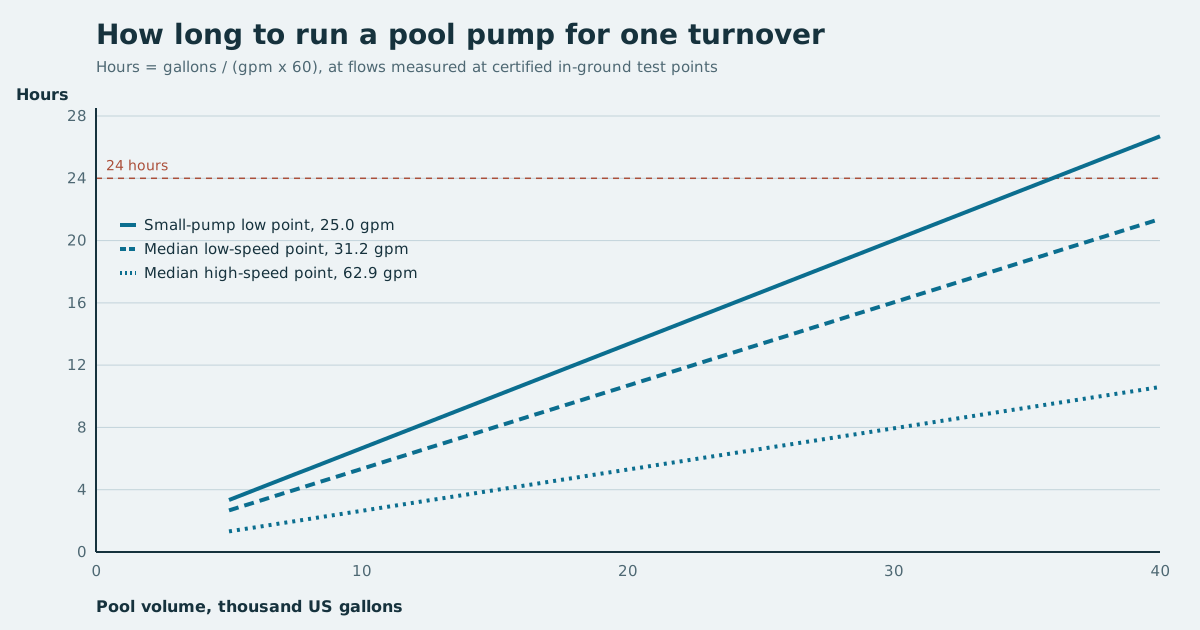
How long to run a pool pump comes down to one division: your pool's volume in gallons, divided by the pump's flow in gallons per minute times 60, gives the hours it takes to push one full volume through the filter. For a 20,000-gallon pool at 31.2 gallons per minute, the median low-speed test flow of a certified variable speed pump, that is about 10.7 hours.
Most advice gives a flat number, usually eight hours. A flat number cannot be right for every pool, because pools differ in volume and pumps differ in flow by a factor of three between their slowest and fastest test points. This guide works through the arithmetic with flows measured on certified pumps, shows what the hours cost, and explains when to run more, less, or at a different time of day.
How long to run a pool pump: the turnover formula
The quantity that matters is turnover time, the hours it takes the pump to move one pool's worth of water through the filter.
Turnover hours = pool gallons ÷ (pump gpm × 60)
The 60 converts gallons per minute to gallons per hour. Two numbers go in. The first is your pool's volume, which you can get from the builder's plan or work out from the pool's dimensions. The second is the flow your pump actually delivers at the speed you run it, which is the harder number to pin down and the one most guides skip.
The U.S. Department of Energy's Building America guide on pool pump retrofits treats one turnover every 24 hours as the minimum, and says turnover time should not be shorter than six hours during normal operation. In between those two bounds, how many turnovers you want is a judgement about bather load, debris and climate.
Pool pump run time by pool size
The table below applies the formula to common pool volumes at five flows. Four are taken from the ENERGY STAR certified pool pump list retrieved on 17 October 2026, which publishes the flow each pump was measured at in its federal test. The fifth is the 66 gpm that the DOE guide gives for a typical 1.5 hp single-speed pump.
| Pool volume (gallons) | 25.0 gpm (small pump, low speed) | 31.2 gpm (median low speed) | 52.3 gpm (small pump, high speed) | 62.9 gpm (median high speed) | 66 gpm (single-speed) |
|---|---|---|---|---|---|
| 10,000 | 6.7 h | 5.3 h | 3.2 h | 2.6 h | 2.5 h |
| 15,000 | 10.0 h | 8.0 h | 4.8 h | 4.0 h | 3.8 h |
| 20,000 | 13.3 h | 10.7 h | 6.4 h | 5.3 h | 5.1 h |
| 25,000 | 16.7 h | 13.4 h | 8.0 h | 6.6 h | 6.3 h |
| 30,000 | 20.0 h | 16.0 h | 9.6 h | 7.9 h | 7.6 h |
| 40,000 | 26.7 h | 21.4 h | 12.7 h | 10.6 h | 10.1 h |
Where the flows come from: across the 108 distinct certified in-ground designs, the median flow at the low-speed test point is 31.2 gpm, and for designs under 0.711 hydraulic horsepower it is 25.0 gpm. At the high-speed test point the medians are 62.9 gpm for all designs that publish one and 52.3 gpm for the small ones. The pool turnover rate calculator does the same arithmetic for any volume and flow, and can take its flow straight from a certified pump's record.
Two things jump out of the table. A variable speed pump running at a slow filtration speed needs roughly twice the hours of an old single-speed pump to move the same water. And a large pool on a small pump at its lowest speed can need more than 24 hours for one turnover, which means it needs a higher speed for part of the day, not just more hours.
Why the slow hours are worth it
Running twice as long sounds expensive until you look at the watts. Pump power falls much faster than flow as speed drops; ENERGY STAR puts it as half the speed for about one eighth of the energy. In the certified records, the median design moves about 16 gallons per watt-hour at its low-speed test point and about 5 at its high-speed point.
Here is one turnover of a 20,000-gallon pool at each flow, priced at the July 2026 U.S. average residential rate of 18.31¢/kWh from the Energy Information Administration:
| How the pool is turned over | Hours | kWh per day | Cost per month (30 days) |
|---|---|---|---|
| Median certified design, low speed (117.66 W at 31.2 gpm) | 10.7 | 1.26 | $6.91 |
| Small certified design, low speed (85.7 W at 25.0 gpm) | 13.3 | 1.14 | $6.28 |
| Small certified design, high speed (513.21 W at 52.3 gpm) | 6.4 | 3.27 | $17.97 |
| Median certified design, high speed (742.25 W at 62.9 gpm) | 5.3 | 3.93 | $21.60 |
| Typical single-speed pump (2,000 W at 66 gpm, DOE figure) | 5.1 | 10.10 | $55.48 |
The same water costs about a third as much at low speed as at high speed on the same certified pump, and about an eighth of what a typical single-speed pump costs. That is why the right answer to how long to run a variable speed pump is usually "longer, slower".
These are test-rig figures, as every cost on this site is. Your plumbing will give a different flow and a different draw; the energy cost calculator takes your own watts and hours.
Pool pump hours per day: one turnover or more?
One turnover does not filter every drop. Filtered water mixes back into the pool, so in a well-mixed pool the share of water that has passed through the filter at least once follows a simple curve:
| Turnovers | Share of water filtered at least once |
|---|---|
| 1 | about 63% |
| 2 | about 86% |
| 3 | about 95% |
| 4 | about 98% |
That is why turnover targets are rules of thumb rather than a guarantee of clean water, and why heavy use calls for more of them. The DOE guide says additional turnovers may be needed for pools with high debris or bather loads, and that higher flow may be needed after a storm or a pool party.
The other side of the argument is in a 2000 DOE fact sheet produced by the National Renewable Energy Laboratory. Reporting a Florida study, it says most owners who cut pumping to under three hours a day were still happy with their water, and that they saved 60% of their pumping electricity on average. It recommends starting at six hours a day and adding half-hour steps only if the water does not look clean. Those owners were running single-speed pumps at full flow, so three hours was still most of a turnover for a typical pool.
A practical reading of both: aim for at least one full turnover a day, and let the water tell you whether you need more.
Public pools are different
Commercial and public pools are governed by health codes, and their turnover requirements are much stricter. The Southern Nevada Health District, for example, requires temporary pools at events to turn over at least every 4 hours and spas every 30 minutes. Requirements vary by state and county and by pool type.
Residential pools are generally not covered by those rules, which is why the hours for a backyard pool are a judgement rather than a legal number. If you run a pool that the public uses, your local code sets the turnover, not this page.
Pool turnover time and your real flow
The weak link in the turnover formula is the flow figure. The certified flow is what the pump moved on a standardised test plumbing curve, and your system almost certainly presents a different resistance.
More resistance means less flow at the same pump speed. Small pipes, many elbows, a long run to the equipment pad, a heater, and above all a filter that is loading up with dirt all add resistance. As a filter clogs, flow drops, and so does the number of gallons filtered in the hours you set. The hours that gave you a full turnover with a clean filter may give you three quarters of one a few weeks later.
There are three ways to find your real flow, from best to worst:
- A flow meter on the return line reads gpm directly. Many variable speed pumps also estimate flow on their display.
- A pressure reading plus the maker's pump curve. The flow rate vs head guide explains how pressure, head and flow relate and how to read a curve.
- The certified flow from the pump's record, used as an optimistic estimate. Treat the hours it gives as a minimum.
When to run a pool pump: off-peak and split cycles
Hours per day is half of a schedule. The other half is when they happen.
On a time-of-use rate, avoid the peak window. Many utilities now charge much more in a few late-afternoon and evening hours. APS in Arizona prices its weekday 4 pm to 7 pm on-peak window at 34.396¢/kWh in summer against 12.345¢/kWh off-peak, and its own plan page tells pool owners to set the timer to run before 4 pm on weekdays. PSEG Long Island's time-of-day tips say the same thing in different words: run the pump before 3 pm or after 7 pm on weekdays.
The gap matters most for the expensive hours. Two daily hours at the median certified high-speed draw of 742.25 W use about 1.48 kWh. On APS's summer prices, those two hours cost about $0.51 on-peak and about $0.18 off-peak, a difference of about $7.20 over 22 weekdays. The same calculation for three hours at low speed comes to about $1.71 a month. So if you can only move one block, move the fast one.
Split the hours into several cycles. ENERGY STAR and the DOE fact sheet both suggest a timer that runs the pump in several shorter periods if debris is a problem, rather than one long block that leaves the rest of the day for debris to collect. Splitting does not change the energy used at a given speed; it changes when the water is moving.
Let other equipment set its own minimum. A heater, salt chlorine generator, suction cleaner or solar panels may need a minimum flow to run, which can mean a higher speed for part of the day. Give that equipment the hours it needs at the speed it needs, and run the rest of the day slow.
Winter, freeze protection and seasonal changes
Cooler water and fewer swimmers mean less demand on the filter. The DOE retrofit study cited above logged its replacement variable speed pump at 6 hours a day in summer and 3 hours in winter, and the old single-speed pump at 6 and 4.
Where winters freeze and the pool stays open, freeze protection changes the picture. A pump with freeze protection runs itself when the air temperature drops, whatever the timer says, so winter hours can rise on cold nights. Some certified records list a freeze protection field, and it is shown on each pump's page.
A worked example
Take a rectangular pool 32 feet long and 16 feet wide with an average depth of 5 feet. That is 2,560 cubic feet, or about 19,150 US gallons at 7.48052 gallons per cubic foot.
Say it has a certified 0.881 hhp variable speed pump; the Hayward EcoStar record is one, measured at 31.55 gpm and 121.09 W at its low-speed point and 60.25 gpm and 626.95 W at its high-speed point.
- One turnover at low speed: 19,150 ÷ (31.55 × 60) is about 10.1 hours, using about 1.23 kWh.
- One turnover at high speed: 19,150 ÷ (60.25 × 60) is about 5.3 hours, using about 3.32 kWh.
- A mixed day: 8 hours slow and 1 hour fast moves about 18,760 gallons, just under one turnover, for about 1.60 kWh.
At 18.31¢/kWh the low-speed day costs about $6.73 a month, the high-speed day about $18.24, and the mixed day about $8.77. If the filter loads up and the real low-speed flow drops by a fifth, the low-speed run needs about 12.6 hours to keep the same turnover.
How to set your hours in practice
- Work out the volume. Use the plan, or length × width × average depth × 7.48052 for a rectangle.
- Find your flow at your filtration speed. Read it from the pump or a flow meter if you can; otherwise use the certified low-speed flow as a starting point.
- Divide. Gallons ÷ (gpm × 60) gives hours for one turnover. Round up.
- Watch the water for a week. If it stays clear, try cutting half an hour. If it clouds, add half an hour or a short high-speed block after heavy use.
- Move the fast hours off-peak if your utility charges by time of use.
- Price the result. Put your watts and hours into the energy cost calculator, or see typical figures in what it costs to run a pool pump per month.
Sources
- ENERGY STAR Certified Pool Pumps dataset, 423 records retrieved 17 October 2026. All certified flows and wattages; the grouping into designs is described on the methodology page.
- DOE Building America, Measure Guideline: Replacing Single-Speed Pool Pumps with Variable Speed Pumps for Energy Savings (Hunt and Easley, 2012): minimum turnover, six-hour floor, single-speed flow and wattage, and the summer and winter hours in its case study. Retrieved 17 October 2026.
- DOE/NREL fact sheet, Conserving Energy and Heating Your Swimming Pool with Solar Energy (2000): the Florida run-time study and the six-hour starting point. Retrieved 17 October 2026.
- ENERGY STAR Pool Pumps: speed and energy, and the advice on several short timer cycles. Retrieved 17 October 2026.
- Southern Nevada Health District, recirculation systems flow requirements: turnover requirements for temporary public pools and spas. Retrieved 17 October 2026.
- APS, Time of Use 4pm to 7pm Weekdays: on-peak window, summer prices and the pool timer advice. Retrieved 17 October 2026.
- PSEG Long Island, pool savings with time-of-day rates: off-peak hours for running a pool pump. Retrieved 17 October 2026.
- EIA Electric Power Monthly, Table 5.3: July 2026 U.S. residential average of 18.31¢/kWh, retrieved 17 October 2026.
Divide your gallons by your real flow times 60, round up, and adjust by the water you see: that is how long to run a pool pump, and the turnover calculator does the division for you.
Frequently asked questions
How many hours a day should I run my pool pump?
Long enough to move the pool's volume through the filter at least once. Divide gallons by gpm times 60. A 20,000-gallon pool at 31.2 gpm, the median certified low-speed test flow, needs about 10.7 hours; at 66 gpm a typical older single-speed pump needs about 5.1.
Is it OK to run a variable speed pool pump 24 hours a day?
On cost, yes at low speed: the median certified design draws 117.66 W there, about 2.8 kWh a day, roughly $15.51 a month at 18.31 cents per kWh. Whether you need 24 hours depends on your volume and flow; many pools reach one turnover in half that.
Should I run my pool pump at night or during the day?
On a time-of-use rate, run it outside the utility's peak window. APS in Arizona, for example, prices weekday 4 to 7 pm at 34.396 cents per kWh against 12.345 off-peak and tells pool owners to run before 4 pm on weekdays. On a flat rate the hour of day does not change the bill.
What is the minimum time to run a pool pump?
The DOE Building America pool pump guide treats one turnover every 24 hours as the minimum and says turnover time should not be shorter than six hours in normal operation. Extra turnovers may be needed after heavy use, storms or high debris.
Do I need to run my pool pump as long in winter?
Usually less. The DOE retrofit study this site cites logged a replacement variable speed pump at 6 hours a day in summer and 3 in winter. Water that is cooler and less used needs less filtration, but freeze protection can override a timer in cold climates.