How Much Does It Cost to Run a Pool Pump per Month?
At the July 2026 U.S. average of 18.31¢/kWh, a certified variable speed pump costs about $8 a month on a 12-hour low schedule. Single-speed: about $66.
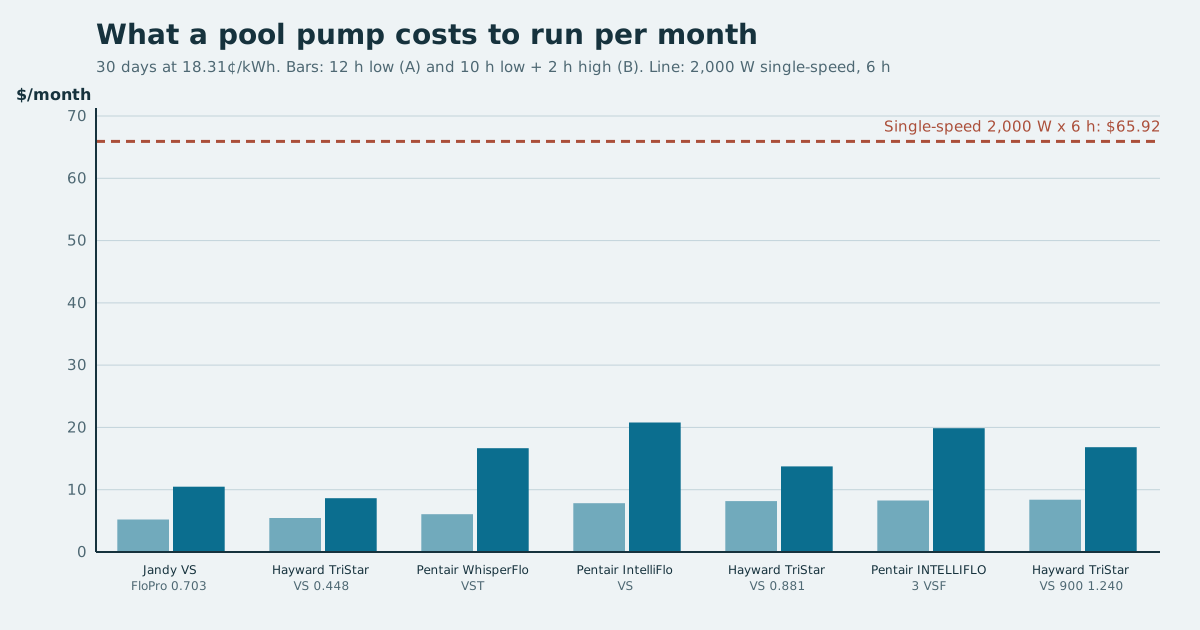
The cost to run a pool pump per month is about $8 for a typical certified variable speed pump run 12 hours a day at low speed, and about $15 if you add two hours a day at high speed. An older 2,000-watt single-speed pump run six hours a day costs about $66 a month. All three figures use the U.S. average residential electricity price for July 2026, 18.31 cents per kWh.
The rest of this page shows the arithmetic, so you can swap in your own pump, hours and rate. Every pump wattage below is a published field from that pump's ENERGY STAR certified record. The schedules and the electricity price are stated assumptions, and each one is named where it is used.
How to work out the cost to run a pool pump per month
Monthly cost = watts × hours per day × 30 ÷ 1,000 × price per kWh
Watts is what the pump draws at the speed you actually run. Hours is how long it runs at that speed. If you run more than one speed, work out each one and add them. The standby draw of the controller, typically a few watts, runs whenever the motor does not.
Here is one pump worked through. The Hayward TriStar VS 900 at 1.240 hydraulic horsepower, the record the certified list spells TirStar VS, draws 124.48 W at its low test point and 891.57 W at its high one, plus 3 W in standby.
- 10 hours at 124.48 W = 1.245 kWh
- 2 hours at 891.57 W = 1.783 kWh
- 12 hours standby at 3 W = 0.036 kWh
- Total 3.064 kWh a day × 30 days × $0.1831 = $16.83 a month
The energy cost calculator does exactly this with your numbers, and shows the formula on screen.
Monthly cost for well-known pumps
Two schedules are used throughout, both this site's stated assumptions rather than measurements. Schedule A: 12 hours a day at the low-speed test point. Schedule B: 10 hours at low, 2 hours at high. Both include standby for the remaining 12 hours and use 18.31¢/kWh over 30 days.
| Pump (certified record) | hhp | Schedule A, 12 h low | Schedule B, 10 h low + 2 h high |
|---|---|---|---|
| Jandy VS FloPro | 0.703 | $5.22 | $10.48 |
| Hayward TriStar VS | 0.448 | $5.46 | $8.64 |
| Hayward Super Pump VS | 0.490 | $5.79 | $9.51 |
| Pentair WhisperFlo VST | 1.640 | $6.07 | $16.66 |
| Pentair SuperFlo VST | 1.001 | $7.70 | $15.18 |
| Pentair IntelliFlo VS | 1.883 | $7.83 | $20.80 |
| Hayward EcoStar / TriStar VS 950 | 0.881 | $8.18 | $13.74 |
| Pentair INTELLIFLO 3 VSF | 1.735 | $8.26 | $19.88 |
| Hayward TirStar VS / TriStar VS 900 | 1.240 | $8.40 | $16.83 |
| Pentair INTELLIFLO 1.5 VSF | 0.896 | $8.66 | $14.54 |
| Median certified in-ground design | — | $7.95 | $14.82 |
Read the two columns together. On a slow schedule, every pump lands between about $5 and $9, because low-speed draws are similar. Add two fast hours and the large pumps pull ahead in cost, since their high-speed draw is far higher. The cheapest pump to run fast is the one that is no bigger than your pool needs, which is what the turnover calculator helps you check.
One caution on the small pumps: they are tested at lower flows, around 25 gpm instead of 31. Twelve hours at 25 gpm moves fewer gallons than twelve hours at 31, so a small pump may need longer hours to turn your pool over. Compare cost per gallon moved, not just cost per hour, when the pumps differ in size.
How many hours you run it
Hours are the lever you control every day. At the median certified low-speed draw of 117.66 W and 18.31¢/kWh, before standby:
| Hours per day at low speed | kWh per day | Cost per month |
|---|---|---|
| 6 | 0.706 | $3.88 |
| 8 | 0.941 | $5.17 |
| 10 | 1.177 | $6.46 |
| 12 | 1.412 | $7.76 |
| 16 | 1.883 | $10.34 |
| 24 | 2.824 | $15.51 |
Even running around the clock at the low test point costs less than two hours a day of a 2,000 W single-speed pump. The expensive hours are the fast ones: every daily hour at the median high-speed draw of 742.25 W adds about $4.08 a month.
That is why a heater, salt cell, suction cleaner or water feature that needs a higher speed can quietly double the bill. If one of them sets your speed, work out how many hours it truly needs and run the rest of the day slow.
Cost per gallon moved
Monthly cost alone can mislead when pumps differ in size, because a bigger pump moves more water in the same hours. Cost per 10,000 gallons puts them on equal terms.
At its low test point the median certified design moves 31.2 gpm at 117.66 W. It takes about 5.3 hours and 0.63 kWh to move 10,000 gallons, about 11.5 cents at 18.31¢/kWh. A 2,000 W single-speed pump moving 66 gpm, the baseline described below, takes about 2.5 hours and 5.05 kWh for the same water: about 92 cents.
Running slower for longer moves the same water for about an eighth of the electricity. How many gallons your pool needs a day depends on its volume and the turnover you aim for, which the turnover calculator works out.
Worked examples for common setups
These use the median certified in-ground design, 117.66 W at its low test point and 742.25 W at its high one, with 3 W standby, at 18.31¢/kWh over 30 days. They show how equipment that needs a faster speed changes the bill.
| Setup | Daily running | kWh per day | Cost per month |
|---|---|---|---|
| Filtration only | 12 h low | 1.448 | $7.95 |
| Filtration, low all day | 24 h low | 2.824 | $15.51 |
| Filtration plus 2 h fast for a heater or feature | 10 h low, 2 h high | 2.697 | $14.82 |
| Filtration plus 3 h fast for a suction cleaner | 9 h low, 3 h high | 3.322 | $18.25 |
The pattern holds for any pump: each fast hour costs roughly what six slow hours do. If an accessory needs a higher speed, the cheapest fix is often to find the lowest speed that still makes it work, rather than the pump's top speed. Its own manual will say what flow it needs.
Single-speed pump cost per month
There is no single-speed in-ground filter pump on the ENERGY STAR list, so a baseline has to come from elsewhere. The Department of Energy's Building America guide on pool pumps describes a typical 1.5 hp single-speed pump as drawing about 2,000 W.
| Hours per day | kWh per day | Cost per month |
|---|---|---|
| 6 | 12.0 | $65.92 |
| 8 | 16.0 | $87.89 |
| 10 | 20.0 | $109.86 |
| 12 | 24.0 | $131.83 |
The same guide notes single-speed pumps typically run at least five to six hours a day, and sometimes around the clock. The full comparison, matched by gallons moved, is in single speed vs variable speed pool pump cost.
Cost over a season
Most pools in cooler climates run for part of the year. This site's default season is 180 days. Over that season at 18.31¢/kWh:
| Pump and schedule | kWh per day | Cost per 180-day season |
|---|---|---|
| Median certified design, Schedule A | 1.448 | $47.72 |
| Median certified design, Schedule B | 2.697 | $88.89 |
| 2,000 W single-speed, 6 hours a day | 12.0 | $395.50 |
For a pool that runs all year, multiply the monthly figure by twelve, and expect to run fewer hours in the cooler months when debris and chemical demand are lower.
Pools that run all year
For a pool that runs every day of the year, the median certified design costs about $96.77 a year on Schedule A and about $180.25 on Schedule B at 18.31¢/kWh. In practice, year-round pools in warm climates often run fewer hours in winter, so treat those as upper figures for an unchanging schedule.
Above-ground pool pumps
Above-ground pumps are a separate class on the certified list, tested at their own conditions. The median above-ground variable-speed design draws 82.7 W at its test point; twelve hours a day of that is about 0.99 kWh, or about $5.45 a month at 18.31¢/kWh. The median above-ground two-speed design draws 251.7 W on its low setting, which comes to about $16.59 a month on the same twelve hours. For an above-ground pool, the step from two-speed to variable speed saves about $11 a month at the national average rate.
How your electricity rate changes the answer
Cost scales directly with your rate. The 18.31¢ figure is the U.S. average residential price for July 2026 from the Energy Information Administration; the 2026 year-to-date average through July was 18.19¢. Your own rate is on your bill, and it may be much higher or lower than the national average.
To show the scaling, here is the same arithmetic at four example rates. The rates other than 18.31¢ are round illustrative numbers, not quoted prices for any place.
| Rate per kWh | Median design, Schedule A | Median design, Schedule B | 2,000 W single-speed, 6 h |
|---|---|---|---|
| 12¢ | $5.21 | $9.71 | $43.20 |
| 18.31¢ | $7.95 | $14.82 | $65.92 |
| 25¢ | $10.86 | $20.23 | $90.00 |
| 35¢ | $15.20 | $28.32 | $126.00 |
If you are on a time-of-use plan, moving pump hours out of the peak window can change the bill more than a pump swap would.
What makes the real number different
These figures are arithmetic on certified test watts. Three things will move your actual cost:
- Your plumbing. Smaller pipes, more fittings and a dirty filter raise resistance, so the pump draws more at the same speed.
- Your speeds. The test points are fixed flows. If you run a higher "low" speed for a heater, salt cell or cleaner, use the watts at that speed.
- Your season. A 30-day month at the same schedule is the simple case. Shorten hours when the water is cold and the pool is lightly used.
Most variable speed pumps show their power draw on the control panel. Reading that number at your usual speed is the fastest way to replace the test figure with your own, and how many watts a variable speed pool pump uses explains how to compare the two.
Lowering the bill without a new pump
If you already have a variable speed pump, most of the saving available is in how it runs, not in replacing it.
- Run slower for longer. The low-speed hours are cheap; the fast hours are not. Find the lowest speed that keeps the water clear and the skimmers working, and run it long enough to turn the pool over.
- Shorten the fast runs. Give each accessory the hours it needs and no more. A cleaner that runs three hours where one would do adds about $7 to $8 a month on the median design.
- Keep the baskets and filter clean. A clogged skimmer basket, pump basket or filter raises resistance, so the pump works harder for the same flow.
- Check the schedule after a power cut. Some controls reset, and a pump left on its top speed costs several times what it should.
- Move hours off peak if your electricity plan charges more at certain times of day.
Checking the figures against your bill
Your electric bill reports total kilowatt-hours for the billing period, and the pump is only one of the things in that total. Two simple checks help separate it out.
First, compare a month with the pool running against a month with it closed, if your season allows. The difference is a rough upper bound on what the pool equipment uses, including any heater and lights.
Second, multiply the watts on the pump's display by the hours on its schedule for each speed, add them up, and multiply by your days in the billing period. If that is far below the difference between the two months, something else on the pool circuit, often a heater or a booster pump, is using the rest. If it is far above, check the schedule actually running on the pump; settings sometimes reset after a power cut.
Sources
- ENERGY STAR Certified Pool Pumps dataset, retrieved 17 October 2026. All pump wattages.
- EIA Electric Power Monthly, Table 5.3, July 2026 U.S. residential average 18.31¢/kWh and 2026 year-to-date 18.19¢/kWh. Retrieved 17 October 2026.
- DOE Building America, Measure Guideline: Replacing Single-Speed Pool Pumps with Variable Speed Pumps for Energy Savings (2012), for the single-speed baseline and typical run hours.
Work out the watts at your speed, multiply by hours and your rate, and you have the cost to run a pool pump each month; the energy cost calculator does the arithmetic for you.
Frequently asked questions
How much does it cost to run a variable speed pool pump per month?
Using certified test watts and 18.31 cents per kWh, a typical variable speed pump costs about $5 to $9 a month on 12 hours of low-speed running, and about $9 to $21 if you add two hours a day at high speed. The median certified design comes to $7.95 and $14.82.
How much does it cost to run a single-speed pool pump per month?
A 2,000 W single-speed pump costs about $66 a month at six hours a day and about $88 at eight hours, at 18.31 cents per kWh.
Is it cheaper to run a pool pump 24 hours a day on low?
It can be cheaper than a few hours on high. At the median low-speed draw of 117.66 W, 24 hours is about 2.8 kWh a day, roughly $15.50 a month. Two hours at the median high-speed draw alone is about 1.5 kWh.
How do I find my pool pump's wattage?
Check the pump's display, which most variable speed models have. Otherwise look up its certified record on the certified pump list, or have the circuit measured with a clamp meter.
Why is my bill higher than these figures?
Your plumbing, higher speeds for accessories, longer hours or a higher electricity rate. The figures here are a like-for-like comparison built on certified test watts, not a prediction for any one pool.