How Many Watts Does a Variable Speed Pool Pump Use?
Certified in-ground variable speed pool pumps draw 71 to 164 W at their low test speed and 369 to 1,295 W at high speed. Measured figures for 108 designs.
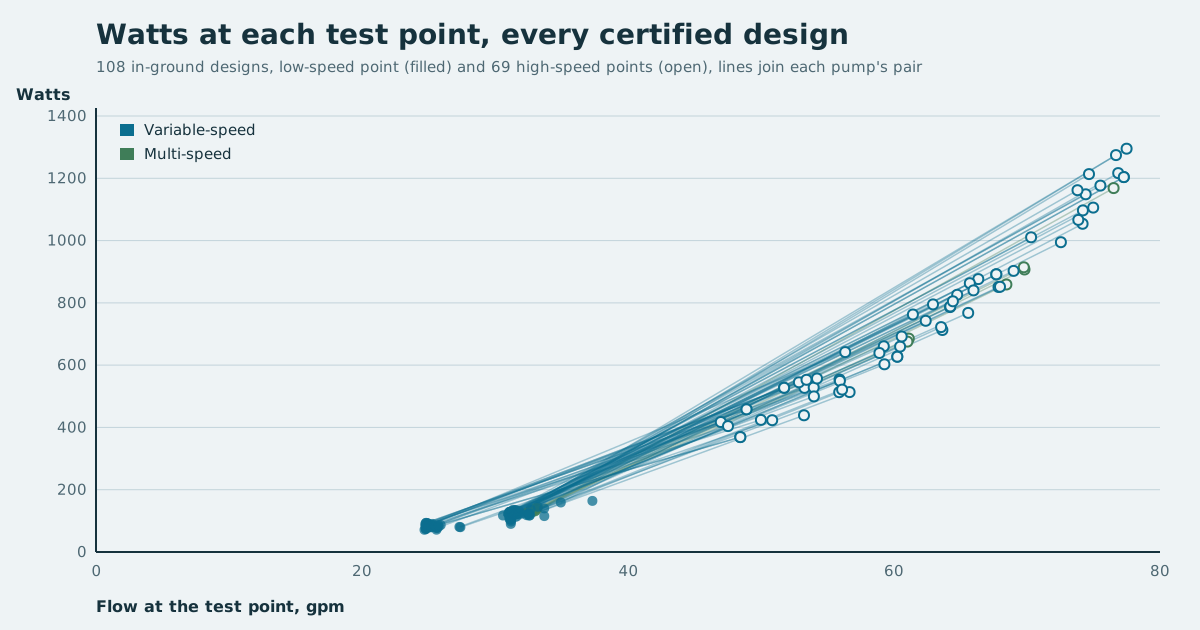
A variable speed pool pump uses about 118 watts at a slow filtration speed and about 740 watts at a fast one, going by the median of 108 certified in-ground designs. The full range runs from 71 W to 164 W at the low test point and from 369 W to 1,295 W at the high one.
Those are not estimates. Every ENERGY STAR certified pump record publishes the input power, flow, head and rpm measured at its test points, and this page summarizes all of them. Most answers to this question give a single rough range. The measured spread is wider at the top and tighter at the bottom than those ranges suggest, and the reason why tells you how to run your own pump for less.
How many watts a variable speed pool pump uses, by test point
The ENERGY STAR list retrieved on 17 October 2026 holds 330 certified in-ground (self-priming) filter pump records: 320 variable-speed and 10 multi-speed. Many are the same hardware sold under several names, so this page groups records with identical measured values into one design. That leaves 108 distinct designs. All 108 publish a low-speed point; 69 also publish a high-speed point.
| Test point | Designs | Lowest | Median | Highest | Median flow at that point |
|---|---|---|---|---|---|
| Low speed | 108 | 71.3 W | 117.66 W | 164.1 W | 31.2 gpm |
| High speed | 69 | 369.09 W | 742.25 W | 1,295.05 W | 62.9 gpm |
| Standby (controller on, motor off) | 66 | 1 W | 3 W | 8 W | — |
Two things stand out. First, the low-speed band is narrow: the middle half of designs draw between about 87 W and 124 W there. Second, the high-speed band is wide, because it tracks pump size. A small pump tested at about 50 gpm and a large one tested at about 77 gpm are doing very different jobs.
The flow column matters as much as the watts. A low-speed figure only means something next to the gallons per minute it was measured at. Across the certified designs the low point sits between 24.7 and 37.3 gpm, which is in the range of ordinary filtration flow for a residential pool.
The figure at the top of this page plots every one of those operating points. Filled marks are the low-speed points, clustered at the bottom left. Open marks are the high-speed points, fanned out to the upper right. The line joining each pair shows how expensively that pump buys its extra flow.
Watts by pump size
Size here means rated hydraulic horsepower (hhp), the water power the pump actually produced in its test. The nameplate motor horsepower is a different and much less useful number; pool pump hydraulic horsepower vs total horsepower explains why.
| Size band | Designs | Low-speed W (min / median / max) | High-speed W (min / median / max) | Median high-speed flow |
|---|---|---|---|---|
| Under 0.711 hhp | 31 | 71.3 / 85.7 / 130.1 | 369.09 / 513.21 / 805.15 (20 designs) | 52.3 gpm |
| 0.711 to under 1.2 hhp | 40 | 74.9 / 122.3 / 164.1 | 513 / 691.82 / 876.27 (25 designs) | 61.1 gpm |
| 1.2 hhp and up | 37 | 90.08 / 123.03 / 159 | 840.1 / 1,081.63 / 1,295.05 (24 designs) | 74.0 gpm |
The low-speed medians barely move between the middle and large bands: about 122 W either way. That is because both are tested at a similar low flow, near 31 gpm. Small pumps are tested lower, near 25 gpm, which is why their low-speed median is about 86 W.
The high-speed medians, by contrast, rise steeply with size. In plain terms, a bigger variable speed pump does not cost much more to run slowly. It costs more when you run it fast.
Why the low-speed number is the one that matters
Pump power falls roughly with the cube of speed, while flow falls roughly in proportion. ENERGY STAR puts it simply: halving the speed cuts the energy to about one eighth. That is why a variable speed pump is cheap to run for many hours at a low setting, and expensive for short bursts at a high one.
You can see it in a single record. The Hayward TriStar VS 900 at 1.240 hhp draws 124.48 W moving 31.41 gpm, and 891.57 W moving 67.69 gpm. Roughly doubling the flow costs about seven times the power.
The median design shows the same thing as water moved per unit of energy. At its low-speed point it moves about 15.9 gallons for every watt-hour. At its high-speed point it moves about 5.1. Each gallon pumped slowly costs about a third as much electricity as a gallon pumped fast.
For comparison, the U.S. Department of Energy's Building America guide on pool pump retrofits describes a typical 1.5 hp single-speed pump as drawing about 2,000 W at full speed, and reports a metered example at 2.07 kW. That is about 17 times the median low-speed draw of a certified variable speed design. The two are not doing identical work per hour, which is why the single speed vs variable speed cost comparison works it out by gallons moved.
Pool pump kWh per day
Watts are a rate; kilowatt-hours are what you are billed for. To turn one into the other, multiply the watts by the hours run and divide by 1,000. At the median low-speed draw of 117.66 W:
| Hours per day at low speed | kWh per day |
|---|---|
| 6 | 0.706 |
| 8 | 0.941 |
| 10 | 1.177 |
| 12 | 1.412 |
| 16 | 1.883 |
| 24 | 2.824 |
Add any high-speed time on top. Two hours at the median high-speed draw of 742.25 W adds about 1.48 kWh, which is more than ten hours of slow running. If you only change one habit, shorten the fast runs.
Put together, the median certified design comes to about 1.45 kWh a day on 12 hours at low speed with standby the rest of the day, and about 2.70 kWh a day on 10 hours at low plus 2 at high. Those two schedules are the ones used across this site's cost pages; they are stated assumptions, not measurements. What they cost in dollars is worked through in how much it costs to run a pool pump per month.
Measured watts for some well-known pumps
These are published fields from each pump's own certified record. Several brand names often share one record, and some model names cover more than one size, so the hydraulic horsepower is listed to show which record is meant.
| Pump (certified record) | hhp | Low-speed W @ gpm | High-speed W @ gpm | Standby W |
|---|---|---|---|---|
| Hayward TriStar VS | 0.448 | 79.79 @ 25.19 | 369.09 @ 48.44 | 3 |
| Jandy VS FloPro | 0.703 | 75.21 @ 24.79 | 553.85 @ 55.90 | 4 |
| Hayward EcoStar, also sold as TriStar VS 950 | 0.881 | 121.09 @ 31.55 | 626.95 @ 60.25 | 3 |
| Pentair INTELLIFLO 1.5 VSF | 0.896 | 124.40 @ 31.17 | 659.47 @ 60.46 | 7 |
| Hayward TirStar VS, also sold as TriStar VS 900 | 1.240 | 124.48 @ 31.41 | 891.57 @ 67.69 | 3 |
| Pentair WhisperFlo VST | 1.640 | 90.08 @ 31.19 | 1,053.99 @ 74.18 | 2 |
| Pentair INTELLIFLO 3 VSF | 1.735 | 119.35 @ 31.19 | 1,176.60 @ 75.52 | 6 |
| Pentair IntelliFlo VS | 1.883 | 114.79 @ 31.24 | 1,295.05 @ 77.49 | 4 |
The Pentair WhisperFlo VST is the outlier worth noticing: a large pump with the lowest low-speed draw of any design of 1.2 hhp or more on the list. "TirStar" is how the certified record spells that Hayward listing.
Multi-speed, above-ground and booster pumps
Multi-speed in-ground pumps are the only non-variable in-ground filter pumps on the list. Their six distinct designs, all Hayward TriStar XE and related listings, draw 126.44 W to 141.52 W at the low test point and 675.53 W to 1,168.39 W at the high one. That puts their low-speed draw slightly above the variable-speed median, with less freedom to pick an in-between speed.
Above-ground pumps are held to a different test minimum and a different job, so their figures should not be mixed with in-ground ones. Grouped the same way, the 83 above-ground records form 27 designs:
| Above-ground speed class | Designs | Low-speed W (min / median / max) |
|---|---|---|
| Variable-speed | 13 | 62.3 / 82.7 / 152 |
| Two-speed | 10 | 195 / 251.7 / 390.9 |
| Multi-speed | 2 | 142.8 and 164.6 |
| Single-speed | 2 | 273 and 361 |
An above-ground two-speed pump on its low setting still draws two to three times what a variable-speed above-ground pump does at its low point.
Pressure cleaner booster pumps are a different machine. The ten certified records are all single-speed, drawing between 839.45 W and 1,015 W at about 10 gpm. They exist to drive a pressure-side cleaner, not to filter the pool, and every hour one runs costs roughly as much as eight hours of a variable speed filter pump at low speed.
Watts on the display versus watts on the record
Most variable speed pumps show their power draw on the control panel. That reading and the certified figure answer different questions.
The certified figure is measured on a test rig against a standard plumbing resistance, defined in the federal test procedure, at a defined flow. It is the fair way to compare one pump with another, because every pump faced the same rig.
The display shows what your pump draws in your plumbing at the speed you set. Smaller pipes, more elbows, a long run to the equipment pad or a filter due for cleaning all add resistance. At a given rpm, more resistance means less flow and usually more watts. So your display can read higher or lower than the certified figure, and neither is wrong.
To compare your pump to the table above, set it to a speed that gives a similar flow, if your system has a flow meter, and read the watts. If not, the display reading at your usual speed is still the right number to put into the energy cost calculator. For a pump with no display, a clamp meter on the supply circuit, used by someone qualified to work on it, gives the same answer.
A quick way to estimate your own pump's watts
There are three ways to find the number for your own pump, from most to least reliable.
- Read the display. Most variable speed pumps show input power in watts on the control panel. Set the speed you normally use, let it settle for a minute, and note the reading. Do the same for any higher speed you use for a cleaner or water feature.
- Find the certified record. If the pump has no display, look up its model on the certified pump list. The low-speed and high-speed watts on the record are the fair comparison figures, with the caveat that your plumbing will shift them.
- Use the label as a ceiling. Multiplying the volts and amps on the motor label gives a figure at or above the most the motor should draw, not what it draws at a slow speed. For a variable speed pump it overstates the slow-speed draw many times over, so it is useful only as an upper bound.
Whichever you use, write down one number per speed you run, and the hours at each. That is all the energy cost calculator needs.
What these numbers do not tell you
These are test-rig measurements on standardized plumbing curves, as described above. The certified figures are a fair way to compare pumps against each other, not a prediction of any one installation.
The list also covers only certified pumps. Since every in-ground filter pump on it is variable-speed or multi-speed, it says nothing directly about an older single-speed pump already in your yard. And because each record publishes at most two operating points, it does not show the watts at every speed in between. Power falls off steeply below the high point, so most intermediate speeds sit much closer to the low figure than a straight line between the two would suggest.
Sources
- ENERGY STAR Certified Pool Pumps dataset, 423 records retrieved 17 October 2026. All wattage, flow, hhp and standby figures; the grouping into designs is described on the methodology page.
- ENERGY STAR Pool Pumps, on speed and energy (half the speed, about one eighth of the energy). Retrieved 17 October 2026.
- DOE Building America, Measure Guideline: Replacing Single-Speed Pool Pumps with Variable Speed Pumps for Energy Savings (Hunt and Easley, 2012), for the single-speed comparison figures.
At its low test point a certified variable speed pool pump uses about 118 watts, and the hours you run it fast decide most of what you pay; put your own watts into the energy cost calculator to see what your variable speed pool pump costs.
Frequently asked questions
How many watts does a variable speed pool pump use on low?
Across 108 certified in-ground designs, the low-speed test point ranges from 71.3 W to 164.1 W, with a median of 117.66 W. Those figures are measured at roughly 25 to 37 gallons per minute, depending on the pump.
How many watts does a variable speed pool pump use on high?
At the high-speed test point, the 69 designs that publish one range from 369.09 W to 1,295.05 W, median 742.25 W. Bigger pumps sit at the top of that range because they are tested at higher flows.
How many kWh does a variable speed pool pump use per day?
At the median low-speed draw, 12 hours a day is about 1.41 kWh. Adding two hours at the median high-speed draw brings it to roughly 2.9 kWh. Your own figure depends on your speeds, hours and plumbing.
How much power does a pool pump use in standby?
The 66 certified in-ground designs that report it draw between 1 W and 8 W in standby, median 3 W. Over the hours the pump is off, that adds up to a few cents a month.
Is a 1.5 hp variable speed pump the same as a 1.5 hp single-speed?
No. Nameplate horsepower says little about water moved. Among certified designs rated 1.5 to 1.65 hp, hydraulic horsepower ranges from 0.341 to 1.242, a 3.6-fold spread. Compare pumps on hydraulic horsepower and flow instead.