DOE Pool Pump Rule: Can You Replace a Single-Speed Pump?
Since July 19, 2021, new pool filter pumps must meet a federal WEF minimum most single-speed models can't. What that means when your old pump fails.
The DOE pool pump rule means that if your single-speed pump fails, its replacement will almost certainly be variable speed. Federal standards for pool filter pumps manufactured from July 19, 2021 set a minimum efficiency that most single- and two-speed pumps of about 1 total horsepower and up cannot meet. A 2023 rule then extended variable-speed requirements to replacement pool pump motors.
The rule does not make you replace a pump that still works. It governs what manufacturers may build or import, not what is already in your yard. Here is what it covers, what it does not, how it compares with the ENERGY STAR label, and what it means in practice when your old pump gives out.
What the DOE pool pump rule requires
The standard sits in the federal energy conservation rules at 10 CFR 431.465. For dedicated-purpose pool pumps that are not submersible, it sets a minimum weighted energy factor (WEF), the gallons a pump moves per kilowatt-hour on a standard test, for pumps manufactured starting July 19, 2021.
| Pump type | Size covered | Minimum WEF |
|---|---|---|
| Self-priming pool filter pump (typical in-ground) | 0.711 to under 2.5 hhp, single-phase | −2.30 × ln(hhp) + 6.59 |
| Self-priming pool filter pump | under 0.711 hhp, single-phase | −1.30 × ln(hhp) + 2.90 above 0.13 hhp; 5.55 at or below 0.13 hhp |
| Non-self-priming pool filter pump (typical above-ground) | under 2.5 hhp | −0.85 × ln(hhp) + 2.87 above 0.13 hhp; 4.60 at or below 0.13 hhp |
| Pressure cleaner booster pump | all | 0.42 |
hhp is hydraulic horsepower, the water power the pump delivers on the test. It is not the motor horsepower printed on older labels; the two are explained in pool pump hydraulic horsepower vs total horsepower.
The rule does not name a technology. It sets a number. But according to manufacturer Jandy's guide, variable speed pumps will in general comply while most single- and two-speed pumps of 1.0 THP or more will not. In practice that has made variable speed the standard for full-size in-ground pumps.
The same rule requires integral cartridge-filter and sand-filter pool pumps, the all-in-one units common with above-ground pools, to be sold with a timer from the same date.
What the certified list shows since
The ENERGY STAR certified list retrieved 17 October 2026 holds 330 in-ground filter pump records. Every one is variable speed (320) or multi-speed (10). There is not a single single-speed or two-speed in-ground filter pump on it. The only single-speed pumps on the list are booster pumps for pressure-side cleaners and three small above-ground records.
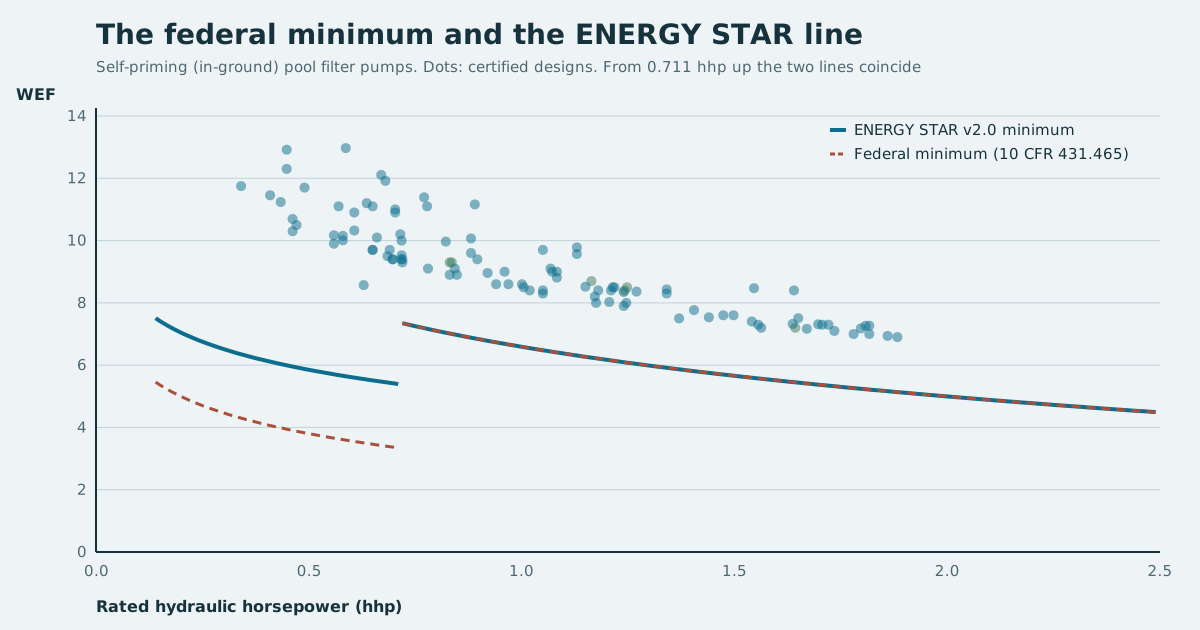
Every certified in-ground design also clears the federal minimum with room to spare. Measured against the federal line for its size, the median design reports a WEF 1.384 times the minimum, and the lowest 1.266 times. The certified list is the efficient end of the market; the federal rule sets the floor under all of it.
What the rule does not cover
The pump standard is narrower than it sounds:
- Submersible pumps are outside the WEF requirements, which apply to dedicated-purpose pool pumps that are not submersible.
- Three-phase self-priming pumps are not in the self-priming lines, which are written for single-phase pumps. The non-self-priming line applies to any motor phase.
- Self-priming pumps of 2.5 hhp and up are outside the table, which covers pumps below 2.5 hhp.
- Pumps already made. Equipment manufactured before July 19, 2021 is not affected by the date.
Pressure cleaner booster pumps are covered, but by a flat minimum of 0.42 rather than a size formula, because their job is to push a cleaner rather than circulate the pool.
Why the standard was set this way
The rule was negotiated with the pool industry and efficiency advocates before DOE adopted it. Industry press at the time reported the view of an energy consultant who helped draft it: that the extra cost of a variable speed pump had fallen far enough to justify making the efficient pump the default, with payback in most areas within about two years depending on local electricity rates.
Writing the rule as a WEF number rather than a technology mandate leaves room for any design that meets the bar. In practice, variable speed is how manufacturers meet it for full-size in-ground pumps.
The replacement motor rule
The 2021 standard covered complete pumps, and the industry press flagged at the time that replacement motors were not covered. That left a route to swap a failed single-speed motor for a new single-speed motor on the old pump body.
DOE closed that route with a final rule published in the Federal Register on 28 September 2023, setting standards for dedicated-purpose pool pump motors whether sold inside a pump or on their own. Under that rule:
| Motor size (total horsepower) | Requirement | Compliance date |
|---|---|---|
| Under 0.5 THP | Minimum full-load efficiency | 29 September 2025 |
| 0.5 to under 1.15 THP | Variable-speed control | Given in the rule's dates section as 28 September 2027 |
| 1.15 to 5 THP | Variable-speed control | 29 September 2025 |
The rule's own summary table gives a different date for the 0.5 to under 1.15 THP class than its dates section does. This page follows the dates section; check DOE's current pool pump motor page before relying on that one date.
Two-speed pumps under the rule
The rule did not ban two-speed pumps by name either. According to Jandy's guide, most two-speed pumps of 1.0 THP or more cannot meet the standard, which matches the certified list: there are no two-speed in-ground filter pumps on it. The 22 two-speed records that are certified are all above-ground pumps, from 0.291 to 0.761 hhp, measured against the lower non-self-priming line.
Replacement motors and your old pump body
The 2023 motor rule matters most to owners whose pump body is fine but whose motor has failed. Under it, a new replacement motor in a covered size must have variable-speed control, so swapping in a new single-speed motor of 1.15 THP or more is no longer an option for motors made from 29 September 2025. Whether a variable-speed motor fits your existing wet end, and works with your controls, is a question for your installer; the certified pump list does not cover motor compatibility.
The ENERGY STAR label and the legal minimum
For in-ground pumps of 0.711 hhp and up, ENERGY STAR's current Version 2.0 minimum is the same equation as the federal standard: −2.30 × ln(hhp) + 6.59. So for full-size in-ground pumps, the label currently marks a pump that meets the legal floor rather than one that beats it. For smaller in-ground pumps and for above-ground pumps, the ENERGY STAR lines are stricter.
| hhp | Federal minimum, self-priming | ENERGY STAR v2.0, self-priming | Federal minimum, non-self-priming | ENERGY STAR v2.0, non-self-priming |
|---|---|---|---|---|
| 0.3 | 4.47 | 6.52 | 3.89 | 5.05 |
| 0.5 | 3.80 | 5.85 | 3.46 | 4.54 |
| 0.7 | 3.36 | 5.41 | 3.17 | 4.21 |
| 0.711 | 7.37 | 7.37 | 3.16 | 4.19 |
| 1.0 | 6.59 | 6.59 | 2.87 | 3.85 |
| 1.5 | 5.66 | 5.66 | 2.53 | 3.44 |
| 2.0 | 5.00 | 5.00 | 2.28 | 3.16 |
Values are the published equations evaluated at each size. The figure at the top of this page draws the two self-priming lines with every certified in-ground design plotted against them: below 0.711 hhp the ENERGY STAR line runs above the federal one; from 0.711 hhp up the two coincide.
That makes the label less useful for choosing between large pumps. Compare each pump's WEF to its class minimum instead; the most energy efficient pool pumps are ranked that way, and the weighted energy factor guide explains the metric.
Timeline
| Date | Event |
|---|---|
| 19 July 2021 | Federal minimum WEF applies to dedicated-purpose pool pumps manufactured from this date; integral filter pumps must ship with a timer |
| 28 September 2023 | Final rule for dedicated-purpose pool pump motors published |
| 29 September 2025 | Replacement motor requirements apply below 0.5 THP and from 1.15 to 5 THP |
| 28 September 2027 | Variable-speed requirement for 0.5 to under 1.15 THP motors, per the rule's dates section |
What this means if your pump fails
- Your working single-speed pump is legal. The standards apply to equipment manufactured on or after the compliance dates.
- A like-for-like single-speed replacement is unlikely. New pumps and, for most sizes, new motors must meet the variable-speed or efficiency requirements.
- Plan for wiring and controls. A variable speed pump may need different electrical work or an automation board change. Ask your installer before the old pump fails, so a breakdown in July does not become a rushed purchase.
- Size the replacement by flow, not by the old horsepower. Old pumps were often oversized. The turnover calculator works out the flow your pool needs.
- The running cost drops sharply. A typical 2,000 W single-speed pump costs about $66 a month at six hours a day at the July 2026 U.S. average rate; a certified variable speed pump moving the same water costs about $8. The math is in single speed vs variable speed pool pump cost.
Above-ground pool owners
Above-ground pumps are covered too, by the non-self-priming line, which is lower than the in-ground one because the job is easier: the pump sits at or below the water level and does not have to lift water to prime. The all-in-one cartridge and sand filter pumps sold with many above-ground pools must also ship with a timer.
The certified list shows what is available. Above-ground records include variable-speed, two-speed, multi-speed and two small single-speed designs. The variable-speed above-ground designs draw 62.3 W to 152 W at their test point, against 195 W to 390.9 W for two-speed designs at their low setting.
How to check a pump before you buy
- Look for WEF and THP on the label or spec sheet. Pumps made from July 19, 2021 must carry both.
- Find its certified record. The certified pump list shows the WEF, the minimum for its class, the size and the measured watts for every ENERGY STAR pump.
- Compare the WEF to the minimum on the same record, not to another pump's WEF.
- Check the watts at the speed you will run, and put them in the energy cost calculator.
Questions to ask your installer
- Does the replacement need a different breaker, wiring or voltage than the old pump?
- Will it work with the timer or automation panel I already have, or does that need a board or a relay?
- What speed will it run at for filtration, and for how many hours? The savings depend almost entirely on this.
- What speed does my heater, salt cell or cleaner need, and for how long?
- Is there a utility rebate for a certified pump in my area, and does it require a particular model or installer?
Where to read the official text
The pump standard is in the Code of Federal Regulations at 10 CFR 431.465, and the replacement motor standard was published in the Federal Register on 28 September 2023; both are linked below. DOE's own pages on dedicated-purpose pool pumps and pool pump motors carry the latest compliance dates and any amendments. Where this page and the official text differ, the official text governs.
Sources
- 10 CFR 431.465, energy conservation standards for pumps: the minimum WEF equations, coverage and the July 19, 2021 compliance date, retrieved 17 October 2026.
- Federal Register, 28 September 2023: Energy Conservation Standards for Dedicated Purpose Pool Pump Motors, Final Rule: replacement motor requirements and compliance dates.
- Jandy, guide to the DOE pool pump regulations: which pump types meet the standard in practice.
- Aquatics International on the federal pump rule: the replacement-motor gap in the 2021 rule.
- NRDC, Pool Pump Standards Talks End with a Splash and an Agreement: the negotiated agreement behind the standard.
- Pool & Spa News, Federal Pump Rule Established: the cost and payback reasoning reported at the time.
- ENERGY STAR Pool Pumps Key Product Criteria: Version 2.0 minimum WEF table.
- ENERGY STAR Certified Pool Pumps dataset, 423 records retrieved 17 October 2026.
This page summarizes federal rules for general information and is not legal advice. In short, the DOE pool pump rule leaves your working pump alone, but when a single-speed pump fails, plan for a variable speed replacement.
Frequently asked questions
Are single-speed pool pumps illegal?
No. Owning or running one is not prohibited. Since July 19, 2021, newly manufactured pool filter pumps in covered sizes must meet a minimum WEF that most single-speed models of about 1 THP and up cannot meet, so they are no longer made for most in-ground uses.
Can I still buy a single-speed pool pump?
Small sizes and older stock may still be available. For in-ground filter pumps, the ENERGY STAR certified list retrieved 17 October 2026 has no single-speed models at all, and replacement motors from 1.15 to 5 THP have required variable-speed control since 29 September 2025.
Does the DOE rule apply to above-ground pool pumps?
Yes. Non-self-priming pool filter pumps under 2.5 hhp have their own, lower minimum WEF, and integral cartridge and sand filter pumps must ship with a timer.
When did the pool pump regulation take effect?
The pump standard applies to pumps manufactured from July 19, 2021. The replacement motor standard took effect for most sizes on 29 September 2025, with a later date for 0.5 to under 1.15 THP motors.
Do I have to replace my single-speed pump now?
No. The rule only affects what is manufactured. Replacing a working single-speed pump early is a cost decision, not a legal one.