Most Energy Efficient Pool Pump: Ranked by Certified Data
The most efficient certified in-ground pool pump is the Aquagem MOOV MP15VSP (115V), at 2.3 times its class minimum. Ranked by size from ENERGY STAR data.
The most energy efficient pool pump on the ENERGY STAR certified list is the Aquagem MOOV VSP MP15VSP (115V). It reports a weighted energy factor of 12.97 against a class minimum of 5.64, clearing it by 2.3 times, the widest margin of any of the 330 certified in-ground records. Hayward's TriStar VS (0.448 hhp record) is the closest challenger at 12.919, and it is the most efficient pump from a major U.S. brand.
That answer changes with pump size, and manufacturers' own "most efficient" claims usually leave that out. Below is the ranking for each size band, the method behind it, what the efficiency difference is worth in dollars, and the data quirk worth knowing before you trust any single number.
How this ranking works
Every certified pump has a weighted energy factor (WEF): thousands of gallons moved per kilowatt-hour on a standard federal test. Higher is better. But small pumps naturally score higher WEF than large ones, so ENERGY STAR sets a different minimum for each size, written as a formula in hydraulic horsepower (hhp).
This ranking divides each pump's WEF by its own published minimum. A ratio of 2.0 means the pump moves twice the water per kWh that its size class requires. That makes a 0.5 hhp pump and a 1.8 hhp pump comparable; raw WEF does not, as the weighted energy factor guide explains.
Records with identical measured values are grouped, because the same hardware is often sold under several brand names. The 330 in-ground records collapse into 108 distinct designs. Each design is ranked once and listed under the names that share it.
The most energy efficient pool pumps, overall
| Rank | Pump (and identical listings) | hhp | WEF | Class minimum | WEF ÷ minimum |
|---|---|---|---|---|---|
| 1 | Aquagem MOOV VSP MP15VSP (115V) | 0.587 | 12.97 | 5.64 | 2.300 |
| 2 | Aquagem MOOV AI MP15AIDV (115V) | 0.670 | 12.11 | 5.47 | 2.214 |
| 3 | Aquagem MOOV VSP MP15VSP (230V) | 0.680 | 11.92 | 5.45 | 2.187 |
| 4 | Hayward TriStar VS / TriStar VS 900 / Smart Max | 0.448 | 12.919 | 5.99 | 2.157 |
| 5 | Hayward JVS185S (115V) | 0.448 | 12.3 | 5.99 | 2.053 |
| 6 | Jandy VS FloPro (WEF 11.0 record) | 0.703 | 11.0 | 5.41 | 2.033 |
| 7 | SPECK BADU Pro-II E VSP / ES90-II VSP, Aqua TechniX equivalents | 0.636 | 11.2 | 5.54 | 2.022 |
| 8 | Jandy VS FloPro (WEF 10.9 record) | 0.703 | 10.9 | 5.41 | 2.015 |
| 9 | Flobot IGP2115VS-NC, Blueworks and Lemonpool equivalents | 0.650 | 11.1 | 5.51 | 2.015 |
| 10 | Hayward Super Pump VS / Super Pump VS 700 | 0.490 | 11.7 | 5.88 | 1.990 |
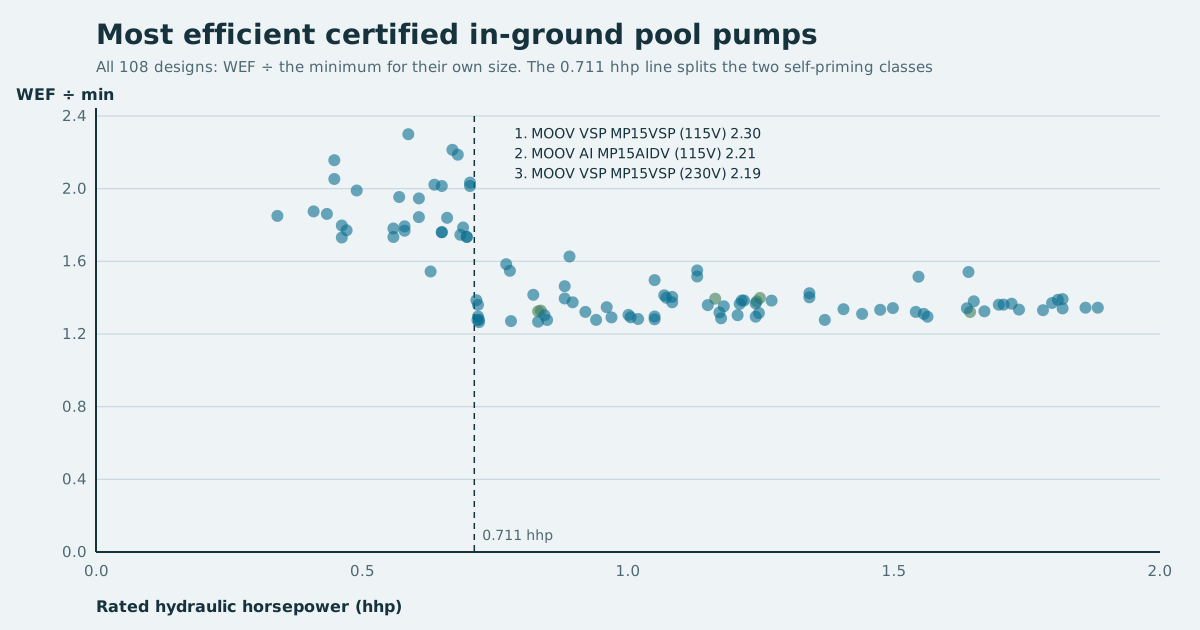
Every pump in the top ten is under 0.711 hhp, and nine designs on the whole list clear their minimum by two times or more, all of them small. That is a real pattern, not a quirk of the method: the median small design clears its minimum by 1.843 times, against 1.338 for mid-size designs and 1.345 for large ones. If your pool only needs modest flow, the most efficient options are all small.
The figure at the top of this page shows the same thing for all 108 designs. Left of the dashed 0.711 hhp line, the small pumps spread high. Right of it, nearly everything sits in a tight band between about 1.26 and 1.63 times the minimum.
Most efficient by size
Most in-ground pools are matched to a mid-size or large pump, so the overall winner may not fit. Here are the leaders in each size band.
Under 0.711 hhp (31 designs)
| Pump | hhp | WEF ÷ minimum | Low-speed W | High-speed W |
|---|---|---|---|---|
| Aquagem MOOV VSP MP15VSP (115V) | 0.587 | 2.300 | 79.7 | 423.2 |
| Aquagem MOOV AI MP15AIDV (115V) | 0.670 | 2.214 | 117.9 | 438.8 |
| Aquagem MOOV VSP MP15VSP (230V) | 0.680 | 2.187 | 80.6 | 499.5 |
0.711 to under 1.2 hhp (40 designs)
| Pump | hhp | WEF ÷ minimum | Low-speed W | High-speed W |
|---|---|---|---|---|
| Aquagem MOOV AI MP15AIDV (230V) | 0.890 | 1.627 | 122.6 | 513.4 |
| Aquagem MOOV AI MP165AIDV (115V) | 0.771 | 1.584 | 116.9 | 513.0 |
| Aquagem MOOV AI MP165AIDV (230V) | 1.130 | 1.550 | 118.1 | 712.9 |
| Aquagem AI SUNBLAZER INVERTECH AI17 (120V) | 0.778 | 1.548 | 121.1 | 521.6 |
| Aquagem AI SUNBLAZER INVERTECH AI17 (240V) | 1.130 | 1.517 | 123.4 | 722.3 |
| GoPiscine / GoPool IG2-2022VS | 1.050 | 1.497 | 115.3 | not published |
1.2 hhp and up (37 designs)
| Pump | hhp | WEF ÷ minimum | Low-speed W | High-speed W |
|---|---|---|---|---|
| Pentair WhisperFlo VST | 1.640 | 1.541 | 90.08 | 1,053.99 |
| Jandy VSSHP220DV2A / VSSHP220DV2AS | 1.546 | 1.515 | 113.65 | 994.75 |
| Jandy VS PlusHP (1.341 hhp record) | 1.341 | 1.424 | 118.60 | 902.77 |
| Advantage Manufacturing Energy Advantage | 1.341 | 1.402 | 113.6 | not published |
| Hayward TriStar XE (multi-speed, 1.248 hhp) | 1.248 | 1.398 | 127.35 | 907.26 |
| Hayward TriStar VS / Smart Max (1.817 hhp) | 1.817 | 1.392 | 117.42 | 1,203.66 |
Aquagem sweeps the two smaller bands. Its MOOV and Sunblazer records were all qualified in April 2026, so they are newer than most of the list and may be less familiar to installers. In the large band, where many in-ground pools sit, the Pentair WhisperFlo VST leads, and it also has the lowest low-speed draw of any large design.
"Not published" means the certified record carries only one measured point. Those pumps cannot be priced on a two-speed schedule from the record alone.
What the efficiency difference is worth
Efficiency ratios only matter if they show up on the bill. Take the large band, where the choice is widest. On this site's standard schedule, 10 hours a day at the low test point and 2 at the high one, with standby the rest of the day, at the July 2026 U.S. average of 18.31¢/kWh:
| Pump | Per month | Per 180-day season |
|---|---|---|
| Pentair WhisperFlo VST (1.640 hhp) | $16.66 | $99.95 |
| Median large certified design (1.2 hhp and up) | $18.77 | $112.62 |
The best large design saves about $2 a month against the median one on this schedule, about $13 over a season. That is worth having, but it is smaller than the saving from picking the right size, or from cutting an hour of high-speed running, which on its own is worth about $4 a month. Efficiency is the tie-breaker once size and schedule are right, not the first decision. The energy cost calculator prices any pump on your own schedule.
The data quirk: same pump, two scores
Look at ranks 4 and 5. The Hayward TriStar VS and the Hayward JVS185S (115V) publish identical measurements: 0.448 hhp, 79.79 W at 25.19 gpm, 369.09 W at 48.44 gpm. Yet one reports a WEF of 12.919 and the other 12.3.
It is not a one-off. Seven groups of in-ground records share identical size and measured watts but report different WEF:
| hhp | Low-speed W | High-speed W | Reported WEF values |
|---|---|---|---|
| 0.448 | 79.79 | 369.09 | 12.919 and 12.3 |
| 0.462 | 93.28 | 458.32 | 10.693 and 10.3 |
| 0.559 | 91.82 | 527.10 | 10.168 and 9.9 |
| 0.881 | 121.09 | 626.95 | 10.067 and 9.6 |
| 1.050 | 128.80 | not published | 8.3 and 8.4 |
| 1.240 | 124.48 | 891.57 | 8.349 and 7.9 |
| 1.817 | 117.42 | 1,203.66 | 7.267 and 7.0 |
The certified list does not say why. It may reflect separate test reports, rounding, or how each listing was entered. The practical lesson: treat a WEF difference of a few percent between near-identical pumps as noise, and look at the measured watts at the flow you need.
Newer is not automatically better
It is tempting to assume the newest pumps are the most efficient. Grouped by the year each design was first qualified, the picture is mixed.
| First qualified | Designs | Median WEF ÷ minimum | Best WEF ÷ minimum | Designs under 0.711 hhp |
|---|---|---|---|---|
| 2019 | 7 | 1.322 | 1.380 | 0 |
| 2020 | 4 | 1.331 | 1.345 | 0 |
| 2021 | 27 | 1.398 | 2.157 | 11 |
| 2022 | 4 | 1.438 | 1.861 | 1 |
| 2023 | 17 | 1.375 | 2.033 | 3 |
| 2024 | 13 | 1.361 | 1.786 | 3 |
| 2025 | 5 | 1.734 | 1.840 | 4 |
| 2026 | 31 | 1.497 | 2.300 | 9 |
The 2026 designs do include the overall leader, but a 2021 design is still fourth on the list, and the 2025 median looks high mainly because four of its five designs are small pumps, which always score higher against their minimum. The year a pump was certified tells you less than its size and its own ratio.
Who makes the top twenty
Across the top 20 designs by ratio, Hayward appears on five, Aquagem on three, and Jandy, Flobot and Blue Torrent on two each. Many designs are sold under several brands, so others appear too: Aqua TechniX, SPECK, LINGXIAO, LX, Blueworks, Lemonpool, Chlorworks, Key Lander and Relaax Water on two each, and Davey, Splash, Circupool and XtremepowerUS on one each. Pentair has none, because it certifies no in-ground pump under 0.896 hhp and every top-20 design is smaller than that. That is a statement about which sizes each brand certifies, not about build quality.
The 0.711 hhp boundary in practice
The ranking changes character at 0.711 hhp, where the self-priming minimum jumps to a stricter line. Just below the boundary, the Jandy VS FloPro at 0.703 hhp clears its minimum by more than two times. Just above it, at 0.715 to 0.720 hhp, the best design manages 1.386 and most sit between 1.265 and 1.361. The pumps are not suddenly worse; the bar they are measured against is higher. Compare designs on the same side of the line, or use the federal and ENERGY STAR minimums explained in the DOE pool pump rule explained.
Above-ground pumps
Above-ground (non-self-priming) pumps are held to a lower minimum, so their ratios are not comparable with in-ground ones. Ranked the same way among the 27 distinct above-ground designs:
| Pump (and identical listings) | Speed | hhp | WEF | Minimum | WEF ÷ minimum |
|---|---|---|---|---|---|
| FLOWORKS AGP1515VS-NC, Blueworks BAPVS1515-NC, Lemonpool LAPVS1515-NC | Variable | 0.490 | 13.1 | 4.56 | 2.873 |
| FLOWORKS SPP1515VS, Blueworks BSPVS1515, Lemonpool LSPVS1515 | Variable | 0.510 | 12.8 | 4.52 | 2.832 |
| GoPiscine / GoPool AG1-1515VS | Variable | 0.527 | 12.5 | 4.49 | 2.784 |
All three leaders are small variable-speed pumps drawing between 62.3 W and 72.2 W at their single published test point.
How to use this ranking
- Start with the size your pool needs. Work out the flow with the turnover calculator, then find the hydraulic horsepower band that delivers it at a comfortable speed.
- Read the leaders in that band, not the overall top ten. The overall leaders are all small pumps; if your pool needs a large one, the large-band table is the one that matters.
- Check both test points. A pump with a single published point cannot be priced on a two-speed schedule from the record. If you will run fast for a cleaner or feature, prefer a pump that publishes its high-speed watts.
- Price it on your schedule. Put the low and high watts into the energy cost calculator with your own hours and rate.
- Treat small WEF differences as a tie. Identical hardware can report WEF a few percent apart, as the table above shows.
What efficient does not mean
- It does not mean cheapest to run in your pool. Efficiency per gallon only pays off if the pump is the right size. An efficient pump that is too small runs longer; one too big wastes power at high speed. Size it first with the turnover calculator.
- It does not mean much above the legal minimum for large pumps, under the current label. For in-ground pumps of 0.711 hhp and up, the ENERGY STAR Version 2.0 line is the same equation as the federal minimum every pump made since July 19, 2021 must meet. Details are in the DOE pool pump rule explained.
- It does not cover reliability, noise or warranty. None of that is in the certified record.
Where to find each pump's full record
The pumps linked above have their own pages on this site, with the full certified specification, the flow-against-power figure from both test points, a running-cost scenario and the closest comparable pumps. Pumps without a link, including the Aquagem records, are on the full certified pump list by brand, model number and WEF; their measured watts are taken from the same ENERGY STAR records used throughout this page.
Sources
- ENERGY STAR Certified Pool Pumps dataset, 423 records retrieved 17 October 2026. All WEF, minimum, hhp, wattage and qualification-date figures.
- ENERGY STAR Pool Pumps Key Product Criteria, Version 2.0 minimum WEF table, retrieved 17 October 2026.
- 10 CFR 431.465, energy conservation standards for dedicated-purpose pool pumps, federal minimum WEF equations, retrieved 17 October 2026.
- EIA Electric Power Monthly, Table 5.3, July 2026 U.S. residential average price, retrieved 17 October 2026.
Measured against its own size class, the most energy efficient pool pump on today's list is the Aquagem MOOV MP15VSP, but the right choice is the most efficient pump that is the right size for your pool.
Frequently asked questions
What is the most energy efficient pool pump?
On the certified list retrieved 17 October 2026, the Aquagem MOOV VSP MP15VSP (115V) has the highest WEF of any in-ground pump, 12.97, and the widest margin over its class minimum, 2.3 times. The best from a major U.S. brand is the Hayward TriStar VS (0.448 hhp record) at 12.919.
What is the most efficient large in-ground pool pump?
Among certified designs of 1.2 hhp and above, the Pentair WhisperFlo VST clears its class minimum by 1.541 times, the widest margin in that size band, followed by the Jandy VSSHP220DV2A at 1.515.
Is the Hayward TriStar VS the most efficient pool pump?
Its 0.448 hhp record is second by raw WEF, at 12.919, behind an Aquagem MOOV record qualified in April 2026, and fourth by margin over its class minimum. It is the most efficient certified in-ground pump from a major U.S. brand.
Is a higher WEF always better?
Only between pumps of the same type and similar size. Compare each pump's WEF to its own published minimum, which is what this ranking does.
Are above-ground pumps more efficient?
They are held to a lower minimum, so their ratios run higher: the top certified above-ground design, listed as the FLOWORKS AGP1515VS-NC and under several other names, clears its minimum by 2.87 times. Above-ground and in-ground figures are not directly comparable.