Pool Pump Hydraulic Horsepower vs Total Horsepower
Hydraulic horsepower is the water power a pool pump delivers; total horsepower is the motor rating. Certified pumps sold at 1.5 hp range 0.34 to 1.24 hhp.
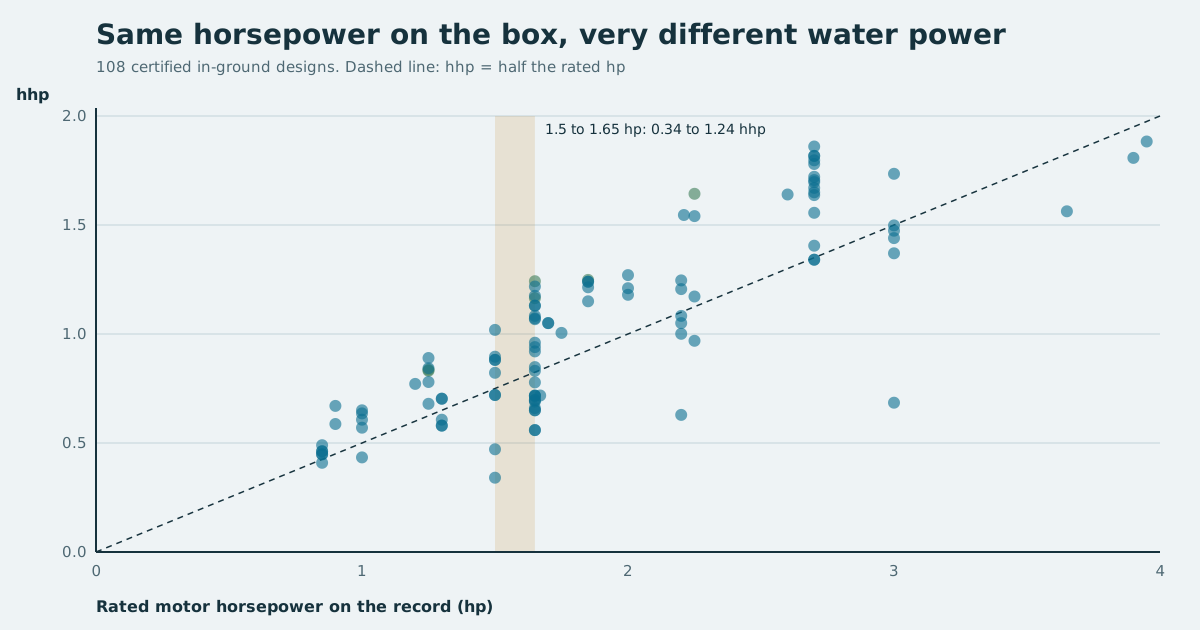
Pool pump hydraulic horsepower vs total horsepower comes down to this: hydraulic horsepower (hhp) is the water power the pump actually delivers on a standard test, and total horsepower (THP) is a rating of the motor. Hydraulic horsepower is the one that tells you what the pump can do, and since 2021 it is the one federal efficiency rules are written around.
The gap between the two is not a fixed conversion. Among certified pumps rated 1.5 to 1.65 motor horsepower, hydraulic horsepower runs from 0.341 to 1.242, a 3.6-fold spread. Two pumps with the same horsepower on the box can move very different amounts of water, and replacing a pump "like for like" by horsepower can leave you with one far too big or too small.
The three horsepower numbers on a pool pump
Hydraulic horsepower (hhp). The power delivered to the water on the federal test procedure. It reflects flow and pressure together, so it is a direct measure of the pump's capacity. ENERGY STAR publishes it on every certified record as "rated hydraulic horsepower."
Total horsepower (THP). A motor rating. Pentair's white paper on the 2021 federal rule pairs it with service factor horsepower: the motor's rated horsepower multiplied by its service factor, the extra load the motor is rated to carry. Since 2021, manufacturers must print THP and WEF on the pump's rating label.
Nameplate, "up-rated" or "full-rated" horsepower. Older industry terms for motor size. The 2021 rule replaced them with THP labeling, so you will still meet them on older pumps and in older parts listings.
Jandy's guide to the rule puts hhp at roughly half of THP as a rule of thumb. The certified data shows how loose that rule is.
Hydraulic horsepower vs total horsepower in the certified data
ENERGY STAR's records publish hydraulic horsepower alongside a rated motor horsepower for each pump. Across the 108 distinct in-ground designs on the list retrieved 17 October 2026, after grouping records that share identical measurements:
| Measure | Value |
|---|---|
| Median ratio, hhp ÷ rated hp | 0.572 |
| Lowest ratio | 0.227 |
| Highest ratio | 0.753 |
| Designs rated 1.5 to 1.65 hp | 35 designs, hhp 0.341 to 1.242 |
| Designs rated 2.7 hp | 15 designs, hhp 1.341 to 1.860 |
The median is close to Jandy's rule of thumb, but individual pumps sit far from it. At 1.5 to 1.65 rated hp, the smallest is the Blue Torrent BT TBVXL150S at 0.341 hhp and the largest is a Hayward TriStar XE record at 1.242 hhp. One is more than three and a half times the other.
The figure at the top of this page shows every design. The dashed line is "hhp equals half the rated horsepower"; the shaded strip is 1.5 to 1.65 rated hp. If the rule of thumb held, every mark would sit on the line. They scatter widely above and below it.
Every rated horsepower on the list
Here is the full spread, by the rated motor horsepower each record publishes.
| Rated hp on the record | Designs | hhp range |
|---|---|---|
| 0.85 | 6 | 0.409 to 0.490 |
| 0.9 | 2 | 0.587 to 0.670 |
| 1 | 5 | 0.434 to 0.650 |
| 1.2 | 1 | 0.771 |
| 1.25 | 6 | 0.680 to 0.890 |
| 1.3 | 5 | 0.580 to 0.703 |
| 1.5 | 9 | 0.341 to 1.019 |
| 1.65 | 26 | 0.559 to 1.242 |
| 1.67 | 1 | 0.718 |
| 1.7 | 2 | 1.050 |
| 1.75 | 1 | 1.005 |
| 1.85 | 5 | 1.150 to 1.248 |
| 2 | 3 | 1.180 to 1.270 |
| 2.2 | 6 | 0.629 to 1.246 |
| 2.21 | 1 | 1.546 |
| 2.25 | 4 | 0.969 to 1.643 |
| 2.6 | 1 | 1.640 |
| 2.7 | 15 | 1.341 to 1.860 |
| 3 | 6 | 0.685 to 1.735 |
| 3.65 | 1 | 1.563 |
| 3.9 | 1 | 1.808 |
| 3.95 | 1 | 1.883 |
Look at the 3 hp row: the smallest design rated 3 hp delivers 0.685 hhp, less than several pumps rated 1.25 hp. The 2.2 hp row runs from 0.629 to 1.246. A motor rating sets an upper bound on what the motor can deliver, not what the pump's hydraulics actually turn into water flow.
Why hhp decides the efficiency rules
The federal standard for dedicated-purpose pool pumps, 10 CFR 431.465, covers self-priming and non-self-priming pool filter pumps below 2.5 hhp, and its minimum efficiency equations are written in hhp. For self-priming pumps the rule splits at 0.711 hhp:
- 0.711 hhp and up: minimum WEF = −2.30 × ln(hhp) + 6.59
- below 0.711 hhp: a separate, lower line
ENERGY STAR uses the same 0.711 hhp boundary for its own minimum. Because the minimum falls as hhp rises, the same WEF can be excellent for a large pump and poor for a small one.
The boundary also creates a step. Under ENERGY STAR's Version 2.0 lines, a self-priming pump at 0.70 hhp needs a WEF of 5.41, while one at 0.711 hhp needs 7.37. A pump that creeps over the boundary faces a much higher bar. That is one more reason to compare a pump's WEF against the minimum printed on its own record, as the weighted energy factor guide recommends, and the DOE pool pump rule explained covers what the federal rule requires.
Hydraulic horsepower and flow
Hydraulic horsepower combines two things a pump does: how much water it moves, and how hard it pushes against the resistance of the plumbing. A pump that moves a lot of water against little resistance and one that moves less water against more resistance can have similar hydraulic horsepower.
For choosing a pool pump, the more useful companion number is the flow at each certified test point, which every record publishes. Across the certified designs, the median flow at the high-speed test point rises with size: about 52.3 gpm for pumps under 0.711 hhp, 61.1 gpm for 0.711 to under 1.2 hhp, and 74.0 gpm for 1.2 hhp and up. At the low-speed point the medians are about 25.0, 31.3 and 31.3 gpm.
So the larger pumps are not mainly faster at low speed; they have more headroom at high speed. If your pool only ever needs filtration flow, a smaller pump can do it, and the larger pump's extra capacity is only worth paying for if something in your system needs high flow.
The 0.711 hhp boundary in the data
The certified list shows the boundary at work. Designs just below 0.711 hhp are measured against the small-pump line, designs just above it against the standard line, and the difference in their ratios is stark:
| Pump | hhp | WEF | Class minimum | WEF ÷ minimum |
|---|---|---|---|---|
| Jandy VS FloPro (WEF 11.0 record) | 0.703 | 11.0 | 5.41 | 2.033 |
| SPLASH; CIPU 72554S / NORTHFLO PMP-72554001 | 0.697 | 9.4 | 5.42 | 1.734 |
| XtremepowerUS 75016 | 0.715 | 10.2 | 7.36 | 1.386 |
| SPLASH; CIPU 72554 | 0.717 | 9.4 | 7.36 | 1.277 |
| DAB E.SWIM 150 | 0.718 | 9.527 | 7.35 | 1.296 |
Two pumps with the same WEF of 9.4, at 0.697 and 0.717 hhp, sit 1.734 and 1.277 times above their minimums. A difference of 0.02 hhp moved them into different classes. When you compare pumps near this size, check which side of the line each sits on.
Why the motor rating runs high
A motor horsepower figure describes what the motor can deliver at its shaft, and a total or service factor horsepower adds the extra load the motor is rated to carry beyond that. The pump's hydraulics then turn shaft power into water flow and pressure, with their own losses. So hydraulic horsepower is always smaller than the motor rating, and by how much depends on how well the wet end, the impeller and volute, is matched to the motor.
That is why two pumps can share a motor rating and differ so much in hhp. A manufacturer may fit the same motor to a smaller and a larger wet end, or rate a motor generously to leave headroom. Neither is wrong, but neither tells you how much water reaches the pool.
Common sizing mistakes
- Replacing by horsepower. An old pump's motor horsepower says little about its flow. Matching it with a new pump of the same rating can land anywhere in the wide ranges in the table above.
- Assuming bigger is safer. A larger pump costs more at its high speed, and older pools often had more pump than they needed. A variable speed pump can be turned down, but its high-speed hours still cost more on a bigger pump.
- Ignoring the plumbing. Hydraulic horsepower is measured on a standard test resistance. A pool with small pipes or a long run to the pump will get less flow from the same pump than the test shows.
- Comparing WEF across sizes. A higher WEF on a smaller pump does not make it the better buy if it cannot move the flow you need.
How to use hhp when choosing a pump
- Work out the flow you need. Pool volume divided by turnover time gives gallons per minute. The turnover calculator does it.
- Shortlist by hhp and measured flow, not motor horsepower. Every certified record shows the flow at its test points. A pump whose high-speed test flow comfortably exceeds your need is big enough.
- Do not oversize. A bigger pump costs more to run fast. In the certified data, the median high-speed draw rises from about 513 W for pumps under 0.711 hhp to about 1,082 W for pumps of 1.2 hhp and up, while low-speed draw barely changes. See how many watts a variable speed pool pump uses.
- Then compare efficiency against the class minimum. The most efficient pumps by size are ranked that way.
A worked example
Four certified pumps, smallest to largest:
| Pump | Rated hp | hhp | High-speed test flow | High-speed W |
|---|---|---|---|---|
| Hayward TriStar VS (0.448 hhp record) | 0.85 | 0.448 | 48.44 gpm | 369.09 |
| Jandy VS FloPro (0.703 hhp record) | 1.3 | 0.703 | 55.90 gpm | 553.85 |
| Pentair INTELLIFLO 1.5 VSF | 1.5 | 0.896 | 60.46 gpm | 659.47 |
| Hayward TirStar VS (1.240 hhp record, also sold as TriStar VS 900) | 1.85 | 1.240 | 67.69 gpm | 891.57 |
Each step up in hhp brings more flow at the high test point and more watts to get it. The motor rating moves too, but not in step: 0.85 to 1.85 rated hp is a little more than double, while hhp goes up nearly three times.
Note also that the Hayward model name "TriStar VS 900" appears on certified records at both 0.448 hhp and 1.240 hhp. A model name alone does not tell you the size; the hhp on the record does.
Reading the label on your own pump
A pump made since July 2021 should carry THP and WEF on its rating label. It may not show hhp; Pentair's white paper notes that hhp labeling is voluntary, and that Pentair adds it to its own labels. If the label lacks it, look the model up on the certified pump list, where every record shows its rated hydraulic horsepower.
An older pump will usually show only a motor horsepower and perhaps a service factor. To estimate what a replacement should deliver, the more reliable route is the flow your pool needs, worked out from its volume, rather than the old motor's horsepower.
The short version
Hydraulic horsepower is what the pump does to the water; total horsepower is what the motor is rated for. The certified data shows the two are only loosely related, so when you compare or replace a pump, use the hydraulic horsepower and test flows on its certified record, and size from the flow your pool needs rather than from the old motor's rating.
Sources
- ENERGY STAR Certified Pool Pumps dataset, retrieved 17 October 2026: all hhp, rated hp, flow and wattage figures.
- 10 CFR 431.465: coverage below 2.5 hhp, the 0.711 hhp split and the minimum WEF equations.
- ENERGY STAR Pool Pumps Key Product Criteria: the Version 2.0 minimum WEF lines either side of 0.711 hhp.
- Jandy, guide to the DOE pool pump regulations: the hhp-to-THP rule of thumb and the THP and WEF labeling requirement.
- Pentair, "Why Hydraulic Horsepower Matters" white paper: definitions of hhp, THP and service factor horsepower, and voluntary hhp labeling.
- Pinch A Penny, 2021 pool pump regulations: the move from special-, max- and full-rate terms to THP.
Compare pumps on measured water power and flow, not the motor rating, and hydraulic horsepower vs total horsepower stops being confusing.
Frequently asked questions
What is hydraulic horsepower on a pool pump?
It is the power the pump delivers to the water on the federal test, combining flow and pressure. ENERGY STAR publishes it on every certified pump record, and federal efficiency minimums are written as equations in it.
What is total horsepower (THP) on a pool pump?
A motor rating that Pentair equates with service factor horsepower: the motor's rated horsepower multiplied by its service factor. Since 2021 manufacturers must print it on the pump's rating label, in place of older terms like up-rated and full-rated.
How do I convert pool pump horsepower to hydraulic horsepower?
There is no exact conversion. A common rule of thumb puts hhp near half of THP, and the certified data's median ratio of hhp to rated horsepower is 0.572, but individual pumps range from 0.227 to 0.753. Look up the pump's certified record for its actual hhp.
Does a higher horsepower pool pump use more electricity?
At high speed, generally yes, because it moves more water. At low speed the difference is small: certified designs from 0.711 hhp upward have median low-speed draws near 122 to 123 W regardless of size.
What hydraulic horsepower do the federal rules cover?
The federal standard for dedicated-purpose pool pumps covers pool filter pumps below 2.5 hhp, with self-priming pumps split at 0.711 hhp into two efficiency classes.