What Size Pool Pump Do I Need? Sizing by Gallons
What size pool pump you need follows from your pool's gallons and turnover target: the gpm to aim for, and which certified pump sizes measure near it.
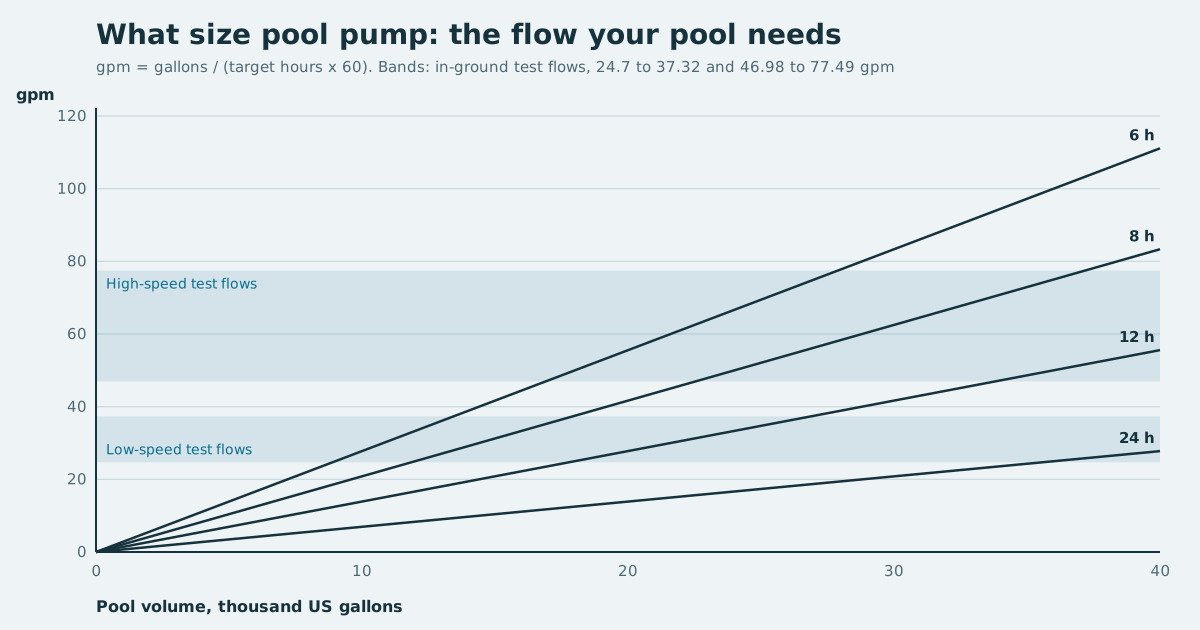
What size pool pump you need is set by flow, not horsepower: divide your pool's volume in gallons by the hours you want for one turnover, then by 60, and you have the gallons per minute the pump must deliver through your plumbing. A 20,000-gallon pool turned over in 8 hours needs about 41.7 gpm; in 12 hours, about 27.8 gpm.
The next step is matching that flow to a pump. Every ENERGY STAR certified pump publishes the flow it moved at its test points, along with its hydraulic horsepower, the water power it delivered. This guide uses those measurements, 108 distinct in-ground designs on the list retrieved 17 October 2026, to show which sizes measure near the flow a given pool needs, and why buying one size up usually costs more than it returns.
What size pool pump: start from the flow
Two numbers decide the flow you need.
Pool volume. For a rectangle, length × width × average depth in feet gives cubic feet; multiply by 7.48052 for US gallons. For a circle, use π × (diameter ÷ 2)² × average depth. Freeform pools are best taken from the builder's plan. The pool turnover rate calculator has a volume helper that does both shapes.
Turnover target. How many hours you want to push one volume through the filter. The DOE Building America guide on pool pump retrofits sets the bounds: at least one turnover every 24 hours, and a turnover time no shorter than six hours in normal operation. Eight to twelve hours is a common middle.
Then: gpm needed = gallons ÷ (target hours × 60).
Pool pump size for gallons: the flow table
| Pool volume (gallons) | 24 h turnover (minimum) | 12 h turnover | 8 h turnover | 6 h turnover | DOE maximum filtration flow |
|---|---|---|---|---|---|
| 10,000 | 6.9 gpm | 13.9 gpm | 20.8 gpm | 27.8 gpm | 36.0 gpm |
| 15,000 | 10.4 gpm | 20.8 gpm | 31.3 gpm | 41.7 gpm | 41.7 gpm |
| 20,000 | 13.9 gpm | 27.8 gpm | 41.7 gpm | 55.6 gpm | 55.6 gpm |
| 25,000 | 17.4 gpm | 34.7 gpm | 52.1 gpm | 69.4 gpm | 69.4 gpm |
| 30,000 | 20.8 gpm | 41.7 gpm | 62.5 gpm | 83.3 gpm | 83.3 gpm |
| 40,000 | 27.8 gpm | 55.6 gpm | 83.3 gpm | 111.1 gpm | 111.1 gpm |
The last column comes from the same DOE guide, which says a pool pump should not have a filtration rate greater than the rate that turns the pool over in six hours, or 36 gpm, whichever is greater. That is why the 10,000-gallon row reads 36 rather than 27.8. The guide puts it another way for small pools: under 13,000 gallons, the pump should be rated at 36 gpm or less for filtration.
Read the table as a range, not a single answer. The 24-hour column is the floor. The six-hour column is the ceiling for filtration. Anything between is a defensible target.
Which certified pump sizes deliver that flow
Certified pumps are tested at two flows. The federal test procedure in 10 CFR 431 Appendix C sets the low test flow at no less than 24.7 gpm for pumps of 0.75 hydraulic horsepower or less, and 31.1 gpm above that. The high test flow is at least 80% of the pump's maximum flow on the test's reference curve C. So the low-speed flows cluster at those two minimums, and the high-speed flows rise with pump size.
Here is what the certified in-ground designs measured, grouped by hydraulic horsepower (hhp):
| hhp band | Designs | Median low-speed flow | Median low-speed watts | Designs with a high point | Median high-speed flow | Median high-speed watts |
|---|---|---|---|---|---|---|
| Under 0.5 | 9 | 24.9 gpm | 87.6 W | 7 | 48.4 gpm | 417.5 W |
| 0.5 to under 0.711 | 22 | 25.0 gpm | 83.0 W | 13 | 53.4 gpm | 528.3 W |
| 0.711 to under 1.0 | 23 | 31.4 gpm | 122.6 W | 15 | 60.3 gpm | 641.9 W |
| 1.0 to under 1.2 | 17 | 31.2 gpm | 122.0 W | 10 | 64.5 gpm | 791.8 W |
| 1.2 to under 1.5 | 17 | 31.4 gpm | 124.5 W | 9 | 68.0 gpm | 891.6 W |
| 1.5 and up | 20 | 31.2 gpm | 120.3 W | 15 | 75.0 gpm | 1,168.4 W |
The pattern answers most sizing questions on its own. Every band can run slowly at 25 to 31 gpm for 83 to 125 W. What a bigger pump adds is headroom at the top: about 48 gpm for the smallest band against about 75 gpm for the largest, at more than double the watts.
Put the two tables side by side. A 20,000-gallon pool on a 12-hour turnover needs about 27.8 gpm, which every band delivers at or near its low test point. The same pool on an 8-hour turnover needs about 41.7 gpm, comfortably inside the high-speed range of even the smallest band. A pump from about 0.5 hhp upward covers that pool's filtration with room to spare.
Matching a pump to your pool: worked examples
A 15,000-gallon pool. An 8-hour turnover needs 31.3 gpm and the DOE ceiling is 41.7 gpm. A small certified pump does this. The Hayward TriStar VS record at 0.448 hhp measured 25.19 gpm at 79.79 W and 48.44 gpm at 369.09 W. Run at a speed between its two test points, or on its low point for about 10 hours, it turns the pool over with plenty of margin.
A 25,000-gallon pool. A 12-hour turnover needs 34.7 gpm; 8 hours needs 52.1 gpm. A mid-sized pump such as the Pentair INTELLIFLO 1.5 VSF at 0.896 hhp measured 31.17 gpm at 124.4 W and 60.46 gpm at 659.47 W. Its low point alone gives one turnover in about 13.4 hours.
A 40,000-gallon pool. Even a 24-hour turnover needs 27.8 gpm, and a 12-hour turnover 55.6 gpm. Here a larger pump is justified, because the low test point of any pump would need more than 21 hours for a single turnover. The Pentair IntelliFlo VS at 1.883 hhp measured 77.49 gpm at its high point, at 1,295.05 W, and 31.24 gpm at 114.79 W at its low point.
In each case the pump's flow will be lower in your plumbing than on the test rig if your system presents more resistance, which is the subject of the next section.
Pool pump sizing and your plumbing
A pump does not have one flow. It has a curve: as the resistance it pushes against rises, the flow it delivers falls. The certified flows are measured against a standard resistance, the parabola H = 0.0082 × Q² in the federal test, where H is head in feet and Q is flow in gpm.
Your pool's plumbing sets its own resistance, and it is often higher than the test's. Smaller pipe, more elbows, a long run to the equipment pad, a heater, and a filter loading with dirt all push the operating point to less flow. The DOE guide notes that small-diameter pipes, hard 90-degree turns, certain filtration devices and high flow rates all raise total dynamic head, and that any resistance removed from the plumbing improves efficiency.
That has two consequences for sizing:
- Pipe size caps useful pump size. A large pump on narrow pipe spends its extra power on resistance, not flow. The flow rate vs head guide shows how to read a pump curve against your system.
- Size with margin, not with a bigger pump. A variable speed pump with some headroom above your target can be turned up as the filter loads. A pump two sizes bigger than you need buys mostly expensive high-speed watts.
Why oversizing costs money
The federal and ENERGY STAR guidance on this has been consistent for a long time. The 2000 DOE fact sheet produced by the National Renewable Energy Laboratory says a larger pump raises pumping and maintenance costs, and reports a Florida study finding that a 0.75 horsepower or smaller pump is generally sufficient for residential pools. The 2012 Building America guide says pool pumps are typically oversized and overused, and that single-speed pumps had to be sized for the most demanding task.
Variable speed pumps soften that penalty, because a big pump can be run slowly. The certified data shows how much: low-speed draw barely changes with size. But they do not remove it. Anything that makes you run fast, a cleaner, a water feature, a spa, costs much more on a large pump. At the July 2026 U.S. average of 18.31¢/kWh, one daily hour at the median high-speed draw of the 1.5 hhp-and-up band costs about $6.42 a month, against about $2.90 for the 0.5 to 0.711 band.
Other equipment sets a floor
The filtration flow is not the only requirement. Equipment on the circulation loop may need a minimum flow to work:
- Skimmers. The DOE guide says most skimmers take about 25 gpm for adequate performance, which is close to the low test flow of the smaller certified pumps.
- Heaters, salt cells and solar panels. Many need a minimum flow to switch on or run efficiently; the manufacturer's manual gives the figure.
- Suction cleaners and water features. These often need a higher speed than filtration for part of the day.
List each one's minimum, take the largest, and check that your shortlisted pump reaches it at a sensible speed. If one item needs high flow for two hours a day, that is the real reason to size up, and the extra cost is in those two hours.
Horsepower, hydraulic horsepower and the label
Sizing by motor horsepower is the habit this guide is trying to replace. Among certified designs rated 1.5 to 1.65 motor horsepower, hydraulic horsepower runs from 0.341 to 1.242. Two pumps sold as "1.5 hp" can differ by a factor of more than three in the water they move.
If you have a shortlist, use the hydraulic horsepower and the two test flows on each pump's certified record, which are on its page in the certified pump list. The difference between the two horsepower figures is explained in pool pump hydraulic horsepower vs total horsepower.
Replacing an existing pump
When an old pump fails, the easy move is to buy the same horsepower again. Three checks give a better answer:
- Work out the volume and the flow you need from the tables above, not from the old pump.
- Note the pipe size at the pump and any equipment with a minimum flow.
- Shortlist certified pumps whose test flows bracket your target. A pump whose low test flow is near your filtration target and whose high test flow covers your largest equipment demand is the right size.
If the old pump was a single-speed model, a federal efficiency rule in force since July 2021 limits what can replace it; the DOE pool pump rule explained covers what that means.
Using the turnover calculator as a pool pump size calculator
The turnover rate calculator runs the sizing arithmetic in both directions. Enter your volume, or the pool's dimensions in its volume helper, and a target turnover in hours, and it returns the gpm you need. Then pick a certified pump from its dropdown: the flow field fills with that pump's measured low-speed flow, and the result shows how many hours that pump needs for one turnover of your pool.
Try two or three pumps from different hhp bands against the same volume. If a small pump's low-speed flow already meets your 12-hour target and its high-speed flow covers your largest equipment demand, a larger pump adds watts rather than useful flow. Once you have a candidate, the energy cost calculator prices the schedule.
What these figures do not settle
These are measurements on a standard test curve, not predictions of a pump in your yard. They are a fair way to compare pumps with each other and to find candidates near your flow. The final check is the manufacturer's full pump curve against your own system's resistance, which a pool professional can work out from pipe sizes and equipment.
Sources
- ENERGY STAR Certified Pool Pumps dataset, 423 records retrieved 17 October 2026. All certified flows, wattages and hydraulic horsepower; the grouping into designs is on the methodology page.
- DOE Building America, Measure Guideline: Replacing Single-Speed Pool Pumps with Variable Speed Pumps for Energy Savings (Hunt and Easley, 2012): minimum and maximum filtration flow, the 13,000-gallon rule, skimmer flow, and total dynamic head. Retrieved 17 October 2026.
- 10 CFR 431, Appendix C to Subpart Y: test flows of 24.7 and 31.1 gpm, the 0.8 × curve C high flow, and the head equation H = 0.0082 × Q². Retrieved 17 October 2026.
- DOE/NREL fact sheet, Conserving Energy and Heating Your Swimming Pool with Solar Energy (2000): the 0.75 horsepower finding and the cost of oversizing. Retrieved 17 October 2026.
- EIA Electric Power Monthly, Table 5.3: July 2026 U.S. residential average of 18.31¢/kWh, retrieved 17 October 2026.
Work out your gallons, pick a turnover between 6 and 24 hours, divide, and shortlist certified pumps whose test flows bracket the result: that is what size pool pump your pool needs.
Frequently asked questions
What size pool pump do I need for a 20,000 gallon pool?
For one turnover in 8 hours you need about 41.7 gpm; in 12 hours about 27.8 gpm. Certified in-ground pumps of 0.711 hhp and up measure a median 31.4 gpm at their low test point, and the 0.5 to 0.711 hhp band reaches a median 53.4 gpm at its high test point, so a pump in either band covers that range.
What size pool pump do I need for a 15,000 gallon pool?
About 31.3 gpm for an 8-hour turnover, or 20.8 gpm for 12 hours. The DOE Building America guide caps filtration flow at the rate that turns the pool in six hours or 36 gpm, whichever is greater, which for 15,000 gallons is about 41.7 gpm.
Is a bigger pool pump better?
Not for filtration. A larger pump costs more to run fast: the median certified high-speed draw rises from about 528 W in the 0.5 to 0.711 hhp band to about 1,168 W at 1.5 hhp and up, while low-speed draw stays near 120 W. Buy for the flow your pool and equipment need.
Can I size a pool pump by horsepower?
Only roughly. Certified pumps rated 1.5 to 1.65 motor horsepower range from 0.341 to 1.242 hydraulic horsepower. Size by flow first, then use the hydraulic horsepower on the certified record to compare candidates.
What is the smallest pool pump I can use?
One that turns the pool over at least once in 24 hours, the minimum in the DOE Building America guide: volume divided by 1,440 gives that flow. Check also that skimmers, heater, cleaner and salt cell get the flow they need; the same guide says most skimmers take about 25 gpm.