Two Speed vs Variable Speed Pool Pump: Measured Watts
Two speed vs variable speed pool pump, from certified test data: at low speed two-speed designs draw 195 to 391 W, variable-speed 62 to 152 W.
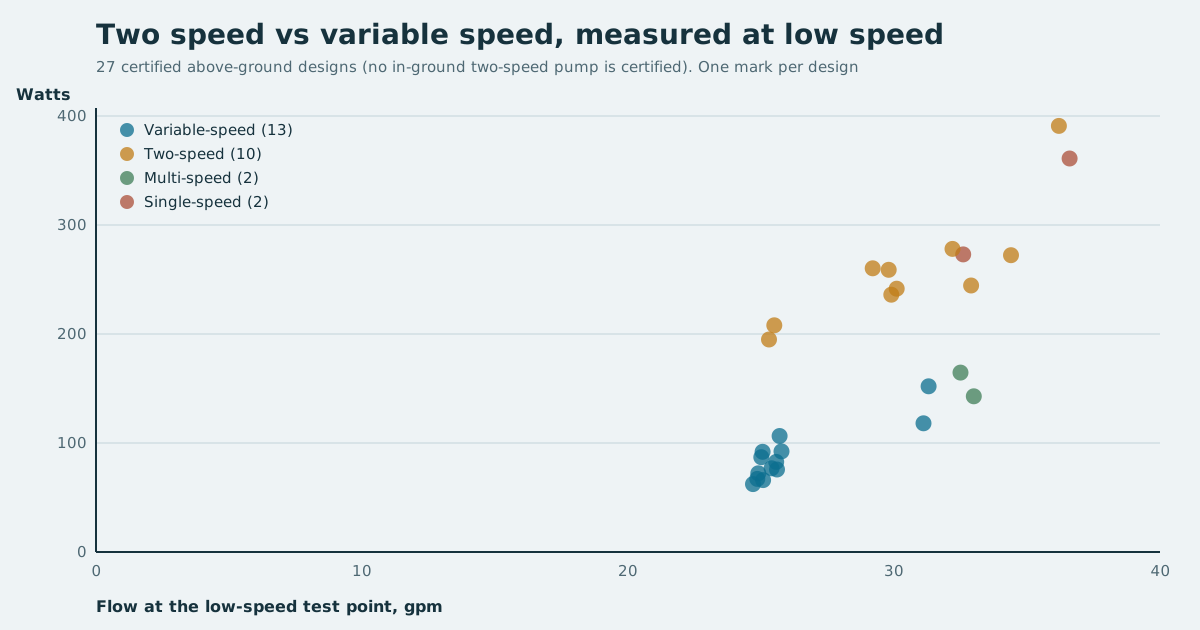
In the two speed vs variable speed pool pump comparison, the certified test data is one-sided: at its low test point, a two-speed pump moves about 7.4 gallons per watt-hour and a variable-speed pump about 18.6, comparing the median above-ground design in each class. Put plainly, a variable speed pump circulates the same water on well under half the electricity.
That comparison has to be made on above-ground pumps, for a reason worth knowing. The ENERGY STAR certified list retrieved on 17 October 2026 has no two-speed in-ground filter pump at all. Its 22 two-speed records are all above-ground pumps. This guide works through what the two designs are, what the certified records measured, what that means in dollars, and when a two-speed pump still makes sense.
What a two-speed pump is, and what a variable-speed pump is
The federal definitions in 10 CFR 431.462 draw the lines precisely.
- Two-speed: a pump that runs at only two preset speeds, with the low speed no more than half the maximum.
- Multi-speed: more than two preset speeds, each at least 100 rpm apart, with the lowest no more than half the maximum, sold with an on-board control that lets you set the duration of each speed.
- Variable-speed: a pump that can run at speeds you choose, no more than 100 rpm apart across its range, with the lowest no more than one third of the maximum, and a variable speed drive.
The DOE Building America guide on pool pump retrofits describes the typical two-speed pump as basically two motors in one: a standard 3,450 rpm full-speed winding and a 1,725 rpm half-speed option. Every two-speed record this site holds in full detail was tested at exactly 1,725 rpm at its low point.
The practical difference is the floor. A two-speed pump's slowest setting is half speed. A variable-speed pump can go to a third of maximum or lower, and the in-ground variable-speed records held in full detail here were tested at low speeds from about 1,000 to 1,700 rpm.
Two speed vs variable speed pool pump: the certified figures
Grouping above-ground records with identical test data into one design gives 27 distinct designs. At the low-speed test point:
| Above-ground speed class | Designs | Low-speed watts (min / median / max) | Low-speed flow (median) | Gallons per watt-hour (median) | Median WEF |
|---|---|---|---|---|---|
| Variable-speed | 13 | 62.3 / 82.7 / 152 | 25.4 gpm | 18.6 | 11.0 |
| Two-speed | 10 | 195 / 251.7 / 390.9 | 30.0 gpm | 7.4 | 5.05 |
| Multi-speed | 2 | 142.8 and 164.6 | 32.8 gpm | 12.9 | 8.3 |
| Single-speed | 2 | 273 and 361 | 34.6 gpm | 6.6 | 6.55 |
The figure at the top of this page plots each design's low-speed point. The two-speed designs sit in a band between about 195 and 391 W, the variable-speed designs mostly below 110 W.
The flows differ a little, which is why the gallons-per-watt-hour column is the fairer comparison. Two-speed pumps were tested at somewhat higher flows, around 30 gpm against about 25 for the variable-speed designs, partly because a two-speed pump's fixed half speed, not a chosen setting, decides the flow it is tested at. Dividing flow by power removes most of that difference, and the gap is still about two and a half to one.
The weighted energy factor tells the same story. The median two-speed design scores 5.05 against a class minimum close to it; the median ratio of WEF to the class minimum is 1.10 for two-speed designs and 2.48 for variable-speed ones. What the score measures is explained in the pool pump weighted energy factor guide.
Two-speed pumps on the certified list, by name
These are the two-speed records held in full detail on this site, with their certified low-speed figures:
| Pump (certified record) | hhp | Rated hp | Low-speed watts | Low-speed flow | WEF |
|---|---|---|---|---|---|
| SharkJet S2TSHJ-6-S | 0.491 | 1.5 | 244.5 | 32.9 gpm | 5.8 |
| SharkJet S2TSHJ9-6-S | 0.654 | 1.5 | 272.3 | 34.4 gpm | 4.8 |
| Orka 16TORK5-S230 | 0.566 | 1 | 278.1 | 32.2 gpm | 4.8 |
| Orka 22TORK5-S230 | 0.761 | 2.2 | 390.9 | 36.2 gpm | 4.1 |
And three above-ground variable-speed records of similar size, for comparison:
| Pump (certified record) | hhp | Low-speed watts | Low-speed flow | High-speed watts | WEF |
|---|---|---|---|---|---|
| Black and Decker BDXBTAGVAR | 0.508 | 76.8 | 25.4 gpm | not published | 12.5 |
| SPECK E71-II VHV | 0.524 | 92.28 | 25.77 gpm | 531.15 at 50.81 gpm | 10.3 |
| Hayward PowerFlo VS 300 | 0.55 | 86.97 | 25.01 gpm | 484.55 at 51.77 gpm | 10.851 |
The two-speed records publish only their low-speed point. The certified dataset holds no high-speed measurement for any of them, so this page does not estimate one.
What the difference costs
Turnover is the fair basis: the same pool volume moved through the filter. For a 15,000-gallon above-ground pool turned over once a day at each class's median low-speed test point, at the July 2026 U.S. average of 18.31¢/kWh:
| Median design at its low test point | Hours for one turnover | kWh per day | Cost per month | Cost over a 180-day season |
|---|---|---|---|---|
| Two-speed (251.7 W at 30.0 gpm) | 8.3 | 2.10 | $11.52 | $69.13 |
| Variable-speed (82.7 W at 25.4 gpm) | 9.8 | 0.81 | $4.47 | $26.83 |
The variable-speed pump runs about an hour and a half longer and uses well under half the energy. Over a season the gap is about $42 at the national average rate; at a higher local rate it grows in proportion.
Scale the pool and the gap scales with it. At 20,000 gallons the same two medians come to about $15.36 and $5.96 a month. Comparing two named records instead, the SharkJet S2TSHJ-6-S and the Hayward PowerFlo VS 300 come to about $10.21 and $4.78 a month for the 15,000-gallon pool.
These are test-rig figures. Your plumbing will give different flows and watts for either pump; the energy cost calculator takes your own numbers.
Why the variable-speed pump wins: the speed floor
Pump power falls roughly with the cube of speed, while flow falls roughly in proportion. The DOE Building America guide illustrates it with a typical 1.5 hp pump: about 2,000 W at 3,450 rpm and 66 gpm, about 250 W at 1,800 rpm and 33 gpm, and about 74 W at 1,200 rpm and 22 gpm. Those are the guide's illustrative figures, not certified measurements.
Read that table with a two-speed pump in mind. Its low speed is 1,725 rpm, close to the 1,800 rpm row: half the flow for about an eighth of the power, which is a big step down from full speed. A variable-speed pump can go further, to the 1,200 rpm row or below, where the same table shows a third of the flow for under 4% of the power. That last step, which a two-speed pump cannot take, is where most of the remaining savings sit.
The guide makes the practical point directly: because a two-speed pump has only two speed choices, it is much more difficult to fine-tune flow for maximum savings. If the half-speed setting cannot do a job, the pump falls back to full speed.
Two speed pool pumps and the federal rule
Federal efficiency standards for dedicated-purpose pool pumps apply to pumps manufactured from July 19, 2021. The rule sets a minimum WEF rather than naming a technology. According to Jandy's guide to the rule, most single- and two-speed pumps rated 1.0 total horsepower or more cannot meet it, while many below 1.0 THP can.
The certified list matches that reading. Every two-speed record on it is an above-ground pump between 0.291 and 0.761 hhp, and there is no in-ground two-speed filter pump at all. For a full-size in-ground pool, the realistic choice today is between variable-speed and multi-speed models. What the rule means if an older pump fails is covered in the DOE pool pump rule explained.
Multi-speed: the middle option
Multi-speed pumps have three or more preset speeds and a built-in timer. On the in-ground side, the certified multi-speed designs are all Hayward TriStar XE and Smart Max listings, drawing 126.44 W to 141.52 W at the low test point. That is close to the in-ground variable-speed median of 117.66 W, so in practice a modern multi-speed in-ground pump behaves much more like a variable-speed one than like a two-speed one.
The two above-ground multi-speed designs, both Orka, draw 142.8 W and 164.6 W at their low point, between the two-speed and variable-speed bands.
When a two-speed pump can still make sense
The certified data does not say a two-speed pump is never the right purchase. It says one costs more to run per gallon. Situations where the gap matters less:
- Short seasons and small pools. On a 10,000-gallon pool turned over once a day, the median two-speed and variable-speed designs come to about $7.68 and $2.98 a month at 18.31¢/kWh. Over a short season that difference may be smaller than any price difference between the pumps.
- Low electricity rates. The gap scales directly with the rate.
- Simple controls. A two-speed pump on a basic timer has fewer settings to manage. Variable-speed pumps need programming to deliver their savings; one left on a high default speed loses most of its advantage.
On the other side, check whether your utility pays a rebate. Many current programmes pay only for ENERGY STAR certified variable-speed pumps; pool pump rebates lists five such offers read on the same day as the data on this page.
Running a two-speed pump for the lowest bill
If you already own a two-speed pump, the same physics tells you how to run it.
- Make low speed the default. Filtration rarely needs full speed. Set the timer so the pump spends nearly all its hours on the half-speed winding.
- Give high speed only to the jobs that need it. A suction cleaner, a spa spillover or a heater with a minimum flow may need it. Work out how many minutes each job really takes and schedule exactly that.
- Lengthen the low-speed run instead of switching up. At half speed the pump moves roughly half the flow, so one turnover takes roughly twice as long. Running longer at low speed still uses far less energy than a shorter run at full speed.
- Keep the filter clean. A loading filter raises the resistance the pump works against, which cuts flow at a fixed speed. A two-speed pump cannot compensate with an in-between setting, so it either loses turnover or gets switched to high.
- Move high-speed hours off-peak if your utility uses time-of-use pricing.
Moving from two-speed to variable-speed: what changes
Owners who replace a two-speed pump with a variable-speed one usually notice three things. The pump runs longer, because the right filtration speed is lower than the old half-speed winding. It is quieter at those speeds. And it needs setting up: a variable-speed pump has a schedule of speeds and times, and the savings depend on that schedule rather than on the hardware alone.
The certified figures for above-ground variable-speed designs that publish a high-speed point, four of the thirteen, show the cost of leaving one on a high setting: 484.55 W to 1,059.33 W, several times their low-speed draw. A variable-speed pump left running fast all day can cost more than the two-speed pump it replaced ran on low.
The how long to run a pool pump guide works out the hours for a given pool volume and flow, which is the first number to set on a new variable-speed pump.
Is a two speed pool pump worth it over a single speed?
Against a single-speed pump, yes, on the certified figures. The two small single-speed above-ground designs on the list draw 273 W and 361 W and move 6.1 to 7.2 gallons per watt-hour; the median two-speed design moves 7.4 on its low setting. The bigger saving for most owners is not between single-speed and two-speed but between either of them and a variable speed pump. The full single-speed comparison is in single speed vs variable speed pool pump cost.
Sources
- ENERGY STAR Certified Pool Pumps dataset, 423 records retrieved 17 October 2026. All watts, flows, rpm, hhp and WEF; the grouping into designs is on the methodology page.
- 10 CFR 431.462, definitions: two-speed, multi-speed and variable-speed dedicated-purpose pool pumps. Retrieved 17 October 2026.
- DOE Building America, Measure Guideline: Replacing Single-Speed Pool Pumps with Variable Speed Pumps for Energy Savings (Hunt and Easley, 2012): two-speed motor speeds, the speed and power table, and fine-tuning. Retrieved 17 October 2026.
- Jandy, guide to the DOE pool pump regulations: which single- and two-speed pumps the 2021 standard rules out in practice. Retrieved 17 October 2026.
- EIA Electric Power Monthly, Table 5.3: July 2026 U.S. residential average of 18.31¢/kWh, retrieved 17 October 2026.
On measured gallons per watt-hour, the two speed vs variable speed pool pump question comes out at about two and a half to one for variable speed; price your own pool's turnover in the energy cost calculator before you buy.
Frequently asked questions
Is a two speed pool pump as efficient as a variable speed?
No, on the certified data. Above-ground two-speed designs move a median 7.4 gallons per watt-hour at their low test point; variable-speed above-ground designs move a median 18.6. The variable-speed pump can be slowed further, and power falls steeply as speed drops.
Can I still buy a two speed in-ground pool pump?
There are none on the ENERGY STAR certified list retrieved 17 October 2026: all 330 in-ground filter pump records are variable-speed or multi-speed. Jandy's guide to the 2021 federal rule says most single- and two-speed pumps of 1.0 THP or more cannot meet the efficiency standard.
What rpm does a two speed pool pump run at?
Typically 3,450 rpm on high and 1,725 rpm on low, according to the DOE Building America pool pump guide. Every two-speed record held in full detail on this site was tested at 1,725 rpm at its low point. Federal rules define a two-speed pump's low speed as no more than half its maximum.
How much more does a two speed pump cost to run?
Turning over a 15,000-gallon pool once a day at each class's median low-speed test point costs about $11.52 a month for a two-speed above-ground design and about $4.47 for a variable-speed one, at 18.31 cents per kWh. Your own figures depend on your plumbing and hours.
What is the difference between a multi-speed and a variable speed pump?
Under 10 CFR 431.462, a multi-speed pump has more than two preset speeds at least 100 rpm apart with the lowest at or below half of maximum; a variable-speed pump can run at user-set speeds no more than 100 rpm apart with the lowest at or below one third of maximum.